
Imperium: the Rise and Fall of an Empire 500 BCE
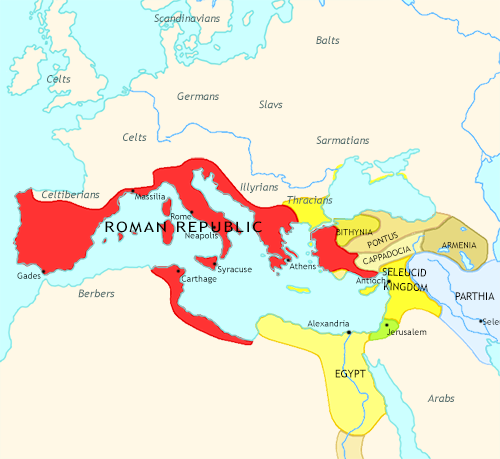
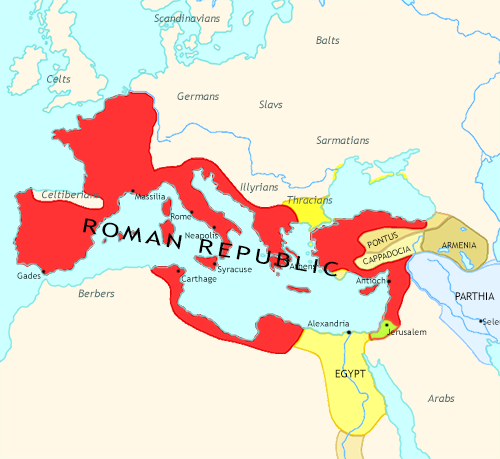
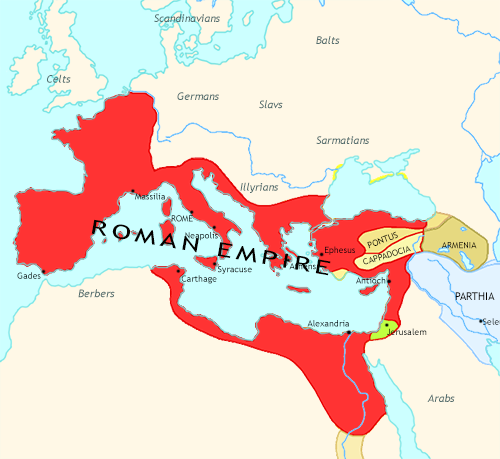
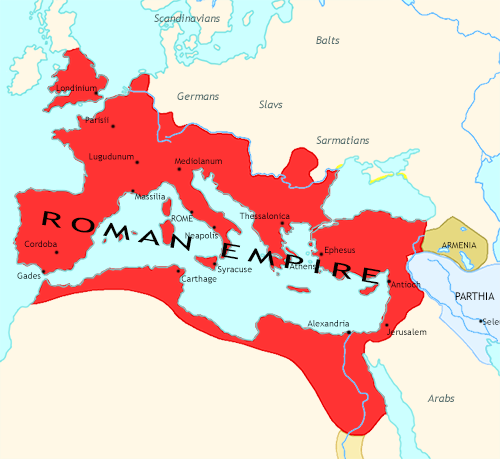
What is happening in Imperium: the Rise and Fall of an Empire in 500BCE
[Premium teacher members: please click here for additional teaching resources for this unit]
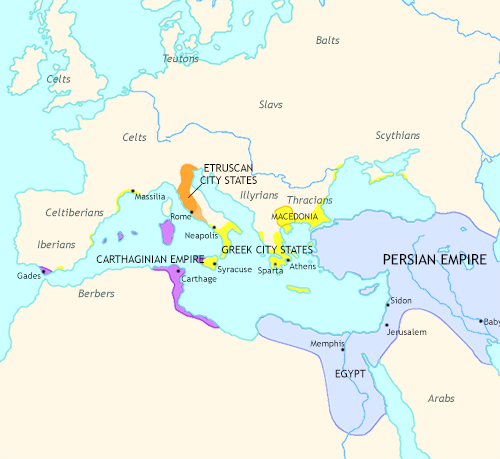
The lands of the eastern Mediterranean belong to the huge Persian empire. The coasts and islands of the central and western Mediterranean, however, are dotted with hundreds of small city-states.
Greeks, Phoenicians and Etruscans
Most of these city-states are inhabited by the Greeks. From their original homeland in Greece and the Aegean the Greeks have settled colonies on the coasts of Italy, Sicily, Sardinia, Corsica, southern France, Spain, the Crimea (in the Black Sea) and North Africa.
Greeks are not the only people to live in city-states. From their homeland in Syria (which has recently become part of the Persian empire) the Phoenicians have founded colonies right across the Mediterranean. By far the most important of these is Carthage, in North Africa. This has become the leading trading power in the western Mediterranean. In Italy, different peoples are gradually turning from tribal societies into city-state societies. The Etruscans are the most advanced of these.
Republics
Politically, most Greek city states have got rid of their kings and govern themselves by means of councils and magistrates. In short, they have become republics. One of the Greek city-states, Athens, has now become a full democracy, governed by an assembly made up of all its (male) citizens. In most of the other states, political offices are usually held by the wealthiest citizens.
The Republican form of government (though not democracy) is now spreading to other Mediterranean peoples. Carthage for example is ruled by a council of its richest citizens.
Art, architecture and literacy
Other features of Greek civilization are also spreading around the Mediterranean. Most important of these is literacy, based on the alphabet. Other important features are Greek art and architecture, and their style of warfare. This involves ordinary citizens (mostly farmers) fighting as heavily armed infantry troops.
Italy in c. 500 BCE
Influenced by the Greek colonies in southern Italy, an Italian people in central Italy called the Etruscans have taken to living in city-states. They are increasingly abandoning the rule of monarchies in favour of republics. They have adopted much of Greek material civilization, such as their art and architecture; and have adapted the Greek alphabet for their own use.
Interestingly, the Etruscans claim to have come from Asia Minor. Modern scholars doubt this, seeing continuity from the prior Villanovan culture of central Italy. This legend may refer to links with the Middle East which brought a more advanced civilization to their part of the world – or maybe, modern scholars are mistaken!
The Etruscans are now at the height of their power. Their league of cities controls most of central and northern Italy.
Rome in c. 500 BCE
The influence of Etruscan civilization has been felt by such neighbouring peoples as the Latins, in central Italy. For example, Etruscan political pressures have been felt by the small Latin city-state of Rome, just to the south of Etruria, and Etruscan cultural influences have been turning Rome from a collection of small villages into a walled urban settlement.
A strategic location
Situated at the point on the river Tiber nearest the sea, where it can be crossed by ford or bridge, Rome is well situated to flourish economically (at least at a local level). Also, at the intersection of various Italian peoples – sophisticated Etruscans, more rustic Latins, and warlike hill people such as the Sabines – Rome has a mixed population and traditions, and is regarded with suspicion by all of these peoples (hence it has foundation legends which refer to its original settlers as a bunch of misfits).
The Early Republic
A series of Etruscan (or Etruscanized) kings have ruled Rome for the past century or so, but in c. 500 BCE Rome, like other city-states, becomes a Republic. It is now ruled by magistrates: above all, two consuls, elected annually, share the responsibilities of chiefs of state and commanders-in-chief of the army. They are advised by a council called the senate, made up of Rome’s hereditary elite, the Patricians. This class monopolizes all political and administrative offices, as well as all Rome’s priesthoods.
As in most other city-sates, the ordinary people – the Plebeians – do have a say in major decisions. The popular assembly has the right to vote “yes” or “no” on such issues as whether or not to go to war. This is necessary because ordinary citizens have to do the actual fighting: the Roman army, like those of other city-states of the time, is composed of ordinary farmers (only those who own their own land are allowed to fight), who are called up for military service during the fighting season each year.
Whether Patrician or Plebeian, only males can participate in public life in any way: all political offices or membership of assemblies is entirely male. There are, however, a few priestesses.
Early Roman society
Roman society is, like that of all societies of the time, an agricultural one. The vast majority of the people are farmers, mostly cultivating their own small plots of land around the urban center.
The elite: Equestrians and Senators
A small minority of families have larger amounts of land, worked by slaves. These more wealthy landowners are the elite who form the equestrian class, so called because they can afford to own and maintain at least one horse and so fight in the army as cavalry. Within this group is an even smaller one, probably just a handful of very high status families. Their members sit in the senate and hold office as magistrates. These are the Patricians.
Traders and artisans
At this date the urban center of Rome is small, and those that live and work here – artisans and merchants and their families – form only a small portion of the total population. Most of early Rome’s sea-going trade, such as it is, is probably in the hands of foreigners such as Etruscans, Greeks and Carthaginians.
Slaves
A large portion of the population is made up of slaves. These are war captives; or those who have sold themselves into slavery for debt; or criminals; or those who arrive as slaves from foreign parts and are sold in the local slave market. Most of these either work on the farms of the better-off, or as domestic servants in their households. Even quite poor Roman families have at least one slave. Although slavery is common and can be brutal, the Romans have a habit of frequently freeing their slaves. Ex-slaves and their descendants are treated as ordinary citizens.
A patriarchal society
Early Roman society is a patriarchal one. The central figure in Roman society is the Pater Familias – the father and householder. Fathers have life and death powers over their children, and even over their wives.
Western and central Europe
The lands of modern day Portugal, Spain, France and Britain, and eastward into Germany and central Europe, are inhabited by warlike tribes sharing an Iron Age culture which today is labelled Hallstatt, or early “Celtic”. They live mostly in small farming villages, but large fortified settlements are to be found where tribal chieftains live with their followers. They do not have literacy.
Further east, the steppes north of the Black Sea are inhabited by the Scythians. They are nomadic pastoralists, excellent horsemen and much-feared warriors. They periodically raid deep into Asia Minor, and have played a leading role in the destruction of more than one state in the region.
[Follow this link to Premium teaching resources on the Roman Empire]
What is happening in Imperium: the Rise and Fall of an Empire in 338BCE
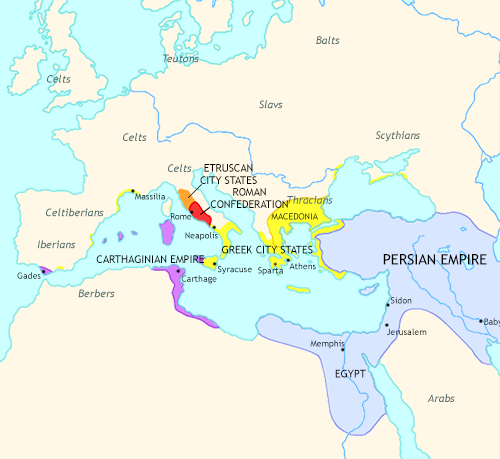
The period between 500 BCE and 338 BCE has seen the Celtic tribes expand outwards from their homelands in central and western Europe. This has had a major impact on the peoples of Italy, especially the Romans.
Western and central Europe
New techniques in arts and crafts deriving from the Greeks and Etruscans have traveled along the trade routes from the Mediterranean into western and central Europe and brought major changes to Celtic material culture. Settlements grow in size, and quite large towns form in chiefly centers. Celtic art is heavily influenced by Mediterranean models.
Celtic expansion
Probably linked to these changes has been a dramatic series of migrations which have taken Celtic tribes southwest into Spain, and southeast into the Balkans. Most significantly, however, at the end of the 5th century BCE or the beginning of the 4th century, they expelled the Etruscans from northern Italy. A large party of them raided down into central Italy (c. 390 BCE). They reached Rome and all but destroyed the city, before heading back north. This was a traumatic experience which stayed with the Romans for the rest of their history.
The Celts – known to the Romans as “Gauls” – have remained in northern Italy, and the Romans called the region Cisapline Gaul – “the land of the Gauls this side of the Alps”.
Italy in the 4th century BCE
Prior to its sack by the Gallic raiders (c. 390 BCE) Rome had steadily been increasing its power amongst its Latin neighbours. In the short term, however, the sack left Roman power severely weakened. They rebuilt their city, and then their power in their neighborhood, in a more determined fashion than before. By 338 BCE they have made themselves the leading power in central Italy.
The Roman alliance system
As well as using their army to good effect, the Romans have used diplomacy to create an alliance of city-states and tribes which has involved granting Roman citizenship and half-Roman (or Latin) citizenship to favoured Allies. These have thus been bound more closely to Rome, and this policy has brought the alliance as a whole more tightly together under Roman leadership.
The creation of this new Roman-led confederation will enable the city to draw on a large and dependable pool of military manpower, further increasing her strength.
The ruling elites of these allied cities are soon intermarrying with the senatorial and equestrian families of Rome, and within a generation the senate itself will begin to include families whose roots lie, not in Rome, but in other central Italian towns.
Rome: internal developments
Internally, politics in Rome has been marked by a prolonged struggle between the small elite, the Patricians, and the majority of ordinary Romans, the Plebeians (this is known in Roman history as the Conflict of the Orders). This has by and large been resolved by this date, with the Plebeians gaining definite rights under Roman law – for example, if charged with a crime they must be tried in a court of law to determine their guilt, and they cannot have their property arbitrarily taken from them. They are also able to elect their own officials, Tribunes of the Plebs, who are responsible for protecting their interests.
Roman Law
Out of this balance of political forces has emerged a legal code which, though strict, and highly patriarchal (early Roman laws emphasise the father in his role as Paterfamilias, confirming his life and death powers over his wife and children), gives all Roman citizens basic legal rights. The foundations of the great system of Roman law have been laid.
A new elite
The Plebeians have also gained the right to elect – and be elected as – magistrates, even consuls. As a result, an elite group of Plebeian families has begun to emerge who, like the Patricians, would provide magistrates and members of the senate on a virtually hereditary basis. In due course Patrician and Plebeian families would intermarry to form a single senatorial aristocracy.
Government
The governing institutions of the Roman republic have matured into a balanced system between executive magistrates, headed by the two annually elected consuls; the senate of the leading men in the state (mostly experienced ex-magistrates themselves), which advises the magistrates and passes laws; and the Plebeian assemblies which give ordinary (male) citizens a voice in major decisions, such as whether or not to go to war, and elect the magistrates, including the new tribunes.
What is happening in Imperium: the Rise and Fall of an Empire in 270BCE
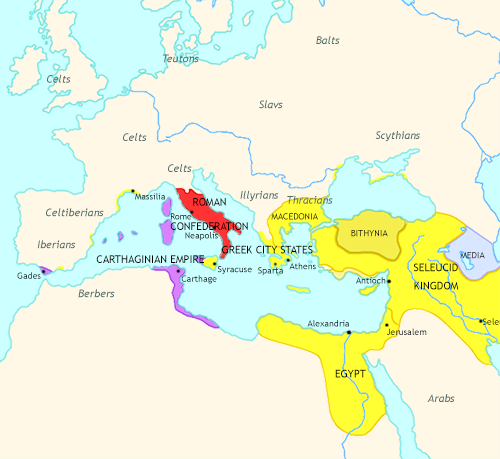
With their control over an enlarge pool of military manpower, the Romans have been able to move out from their base in central Italy and conquer most of the rest of the peninsula. This has involved hard fighting against tough hill tribes, above all the warlike Samnites. The outstanding area which remains to be subdued is the Gallic area of northern Italy (Cisapline Gaul).
The Roman alliance system
The Romans have continued their policy of granting citizenship and half-citizenship (or Latin citizenship) to close Allies, and this has given their leadership of the rest of the Italian tribes and cities a solid foundation.
Roman control is further enhanced by their policy of establishing colonies of Roman citizens and Latin citizens at strategic locations throughout Italy. Initially they form pockets of loyal settlers amongst potentially hostile populations; later they will come to act as centers from which the Latin language and Roman ways spread throughout Italy.
These colonies are connected to Rome by a growing network of well-built roads, along which troops can be hurried in times of emergency. These roads have the further advantage of boosting trade and interconnecting Italy commercially as well as culturally.
Greek influence
With Roman power now reaching into southern Italy, a number of Greek cities have come under her control. This has not been without stiff resistance, with the Greeks calling over a famous commander from the Greek mainland, Pyrrhus, king of Epirus, to help them. Although Pyrrhus won some battles, these “Pyrrhic victories” were at such cost that he gave up and went home, advising the Greeks of Italy to submit to the Romans.
The conquest of the Greek cities of southern Italy is reinforcing Greek cultural influences on wealthier Romans, who are beginning to acquire a taste for Greek art, architecture and literature. This is much to the disgust of conservative Romans, who regard such influences as alien and softening.
The Legions
In the course of their conquests, the Romans have developed their distinctive military organization based on the legion.
A legion is not just one large body of men, as Greek formations are. It is divided into autonomous units of 100 men each, called centuries, which are able to fight independently. This gives the legion much more flexibility than the forces of other states. The commanders of these unit, the centurions, are soldiers of long experience and proven ability, and from this time on they become the backbone of the Roman army.
More magistrates
The expansion of Roman power further and further away from Rome has required some adjustment to the structure of high offices. The two consuls (chief magistrates) now spend most of their time commanding different armies on campaign. An increasing number of magistrates (all elected annually) are therefore emerging, to deal with the growing number of civilian and administrative matters needing attention.
Also, the Romans have increasingly had to put more than two armies into the field at a time. But only two consuls (who command the armies) can hold office at any one time. The senate therefore resorts to extending consuls’ commands on an ad hoc basis, calling them proconsuls (a term which means “in place of” consuls). More will be heard of such officials as Rome’s empire grows – and they will eventually play a key role in the downfall of the Republic.
Carthage
The trading city of Carthage is located in North Africa. It was founded by Phoenician colonists back in the early 9th century BCE. The Carthaginians have been vigorous commercial rivals of the Greek cities of Sicily and southern Italy, and have built up a powerful maritime influence in the western Mediterranean. They have sent out their own colonies along the north coast of Africa and to the south coast of Spain, as well as to Sicily, Sardinia and Corsica.
The commercial and territorial rivalry between the Greek city states in the west and Carthage has caused recurrent tensions, and several hard-fought but indecisive wars.
During Alexander the Great’s conquests of the East, the Phoenician city of Tyre was destroyed. This has left Carthage as the most important of the Phoenician city-states, its wealth reinforced by the treasures brought by rich Tyrians fleeing their city.
For centuries the Carthaginians have dominated the trade – and the international power-politics – of the western Mediterranean. They have been eyeing the expansion of Roman power in the Italian peninsula with growing anxiety.
What is happening in Imperium: the Rise and Fall of an Empire in 200BCE
In the 260s, tensions increased between the Romans and the other leading power of the western Mediterranean, Carthage. The Romans called the resulting war the First Punic War because Carthage was originally a Phoenician colony, and the Latin for “Phoenician” is Punicus.
The First Punic War
To defeat the primary naval power in the western Mediterranean, the Romans had to build a powerful navy from scratch. After some dreadful losses (mostly to storms), the Romans were able to gain control of the seas around Italy and Sicily. This enabled her army to score some major successes against the Carthaginians in Sicily and North Africa.
One of the provisions of the peace treaty that ended the war was that Carthage was not to rebuild a powerful fleet.
The Carthaginians did not take their defeat lying down. Over the next 20 years they carefully built up their power in Spain. By 220 BCE the man in charge in Spain was Hannibal.
The Second Punic War
In 218 he led a large army out of Spain, across southern Gaul, on across the Alps, and down into northern Italy, taking the Romans completely by surprise. (He had been unable to sail it across to Italy as the Romans had controlled the seas). His army was then joined by Gallic tribal forces in northern Italy, and he invaded south into Roman territory.
Over the next three years Hannibal’s army destroyed three large Roman armies sent against it. The last of these victories was at Cannae (216 BCE), in southern Italy. The Romans came to regard this as the worst defeat they ever suffered in their history.
Hannibal then demanded Rome’s surrender – but the senate refused. Hannibal then hoped to raise Rome’s Allies against her; but only a few cities went over to him. The majority remained staunchly loyal.
For the next 10 years or so Hannibal marched his army up and down Italy to little effect. He was unable to receive support from Home, or even from Spain, as the Romans controlled the seas around Italy. The Romans carefully nursed their strength, and when they were ready, went over to the offensive.
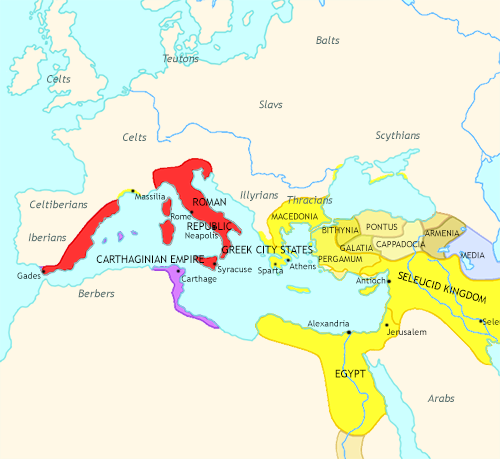
While avoiding battle in Italy, Roman armies drove the Carthaginians out of Spain and Sicily. They then invaded the Carthaginian home territory in North Africa.
The Carthaginians quickly recalled Hannibal to command their defences, but the Romans won a great victory at the battle of Zama, in 202 BCE. This ended the Second Punic War.
An overseas empire
Victory against Carthage has left Rome with an overseas empire, having taken over territories which the Carthaginians had previously dominated. These new possessions are divided into four provinces: the islands of Corsica and Sardinia; Sicily; and Spain, which the Romans have turned it into two provinces, Further Spain and Nearer Spain.
Changes in government
In the course of the long war with Carthage, Roman armies have spent years at a time on campaign, often overseas in Spain, Sicily and North Africa. To provide continuity of command, their generals have also had to spend many years in post.
To enable this to happen in a political system based on annually elected magistrates, the senate has had the popular assemblies elect experienced and successful commanders to be consuls. (Early in the second war, the Plebeians elected popular politicians with little military experience, but this led to disaster on the battlefield. The assemblies thereafter tended to follow the advice of the senate, which is full of very experienced politician-generals).
As consuls, these men assumed command of the Roman armies in one or other of the major theatres of war, and the senate then extended their commands, sometimes for many years, with the office of proconsuls.
Provincial administration
In peacetime, much the same system operates (in fact the Latin word provincia means “field of responsibility”).
Each province is placed under a a consul (if a major war is being undertaken there) or more usually a more junior magistrate called a praetor. Like all Roman magistrates, these are elected for a one year term only. However their responsibilities can be extended by the senate, with the title of propraetor or proconsul.
The primary duties of these governors is to command the troops stationed in the province, and to look after the interests of Rome – by, for example, dealing with the leaders of the subject communities, or building and maintaining roads along which troops can march speedily. He also has responsibilities for Roman citizens in the province: whist the native peoples in the provinces continue under their own laws and customs, Roman citizens come under the jurisdiction of the governor. His role therefore combines that of military commander, civil administrator and judge.
The native elites in the subject cities and tribes continue to look after all internal matters within their borders. So long as they forward their tribute to the governor, refrain from waging any war without Rome’s permission, and maintain law and order within their territories, they are left more or less undisturbed by the Roman authorities.
This arrangement means that a Roman governor needs only a very small administrative staff to aid him. He has a junior magistrate (a quaestor) to assist him, mainly in financial matters. Otherwise he relies on a small group of soldiers seconded to his staff as clerical orderlies, plus a handful of personal secretaries, often his own slaves and freedmen.
With only small adjustments, this is the provincial system which will operate for centuries to come. The idea that the Romans developed a huge bureaucracy is wide of the mark, at least before the period of the Late Empire.
Changes in Roman society and culture
The city of Rome itself has been expanding strongly since becoming the effective capital of Italy. Wealth has been flowing into it, and the equestrian class, hitherto one of small landowners, now includes a group of rich businessmen.
Their wealth is augmented by the senate’s need to organize long and expensive campaigns overseas, and its unwillingness to create the bureaucratic machinery to do this. Instead, the senate farms out this challenging task to companies of private contractors, owned and managed by wealthy Roman businessmen – who cream off a healthy profit in the process.
The beginnings of Latin literature
Wealthy Romans’ taste for Greek literature and art is leading Latin authors to translate works from Greek. Some go further by writing original Latin works based on Greek models. The playwright Plautus is the outstanding example.
The Greek East
At the height of the war against Hannibal, just when the situation of the Romans looked at its most hopeless – after the battle of Cannae in 216 – the king of Macedonia (just north of Greece) declared war on them.
The Romans, unable to spare a major army to either invade Macedonia or even defend their Adriatic coast, sent a small fleet to patrol the Adriatic and protect their eastern flank. This succeeded in keeping the Macedonian army out of Italy.
The Romans will not forget this action of the Macedonians at the time to their greatest weakness. Soon, for the first time, they will become heavily involved in the Greek-speaking Hellenistic world of the eastern Mediterranean.
The Hellenistic world
In the wake of Alexander the Great’s conquests and early death, the lands of the eastern Mediterranean have become divided into numerous states. The largest of these are the kingdoms of Syria (the Seleucid kingdom), Egypt (the Ptolemaic kingdom) and Macedonia. Each kingdom is under a dynasty descended from one of Alexander the Great’s generals. Smaller kingdoms in Asia Minor have also emerged.
Greece itself is still covered by many small city-states, as it has been for centuries. Now, however, most of these have formed themselves into leagues to protect themselves against the larger kingdoms.
Alexander and his successors founded numerous colonies across the Middle East and into India, which have become thriving centres of a Hellenistic (“Greek-like”) civilization. Some of these cities, such as Alexandria, capital of Egypt and Antioch, capital of the Seleucid empire, have grown to become among the largest and richest cities in Antiquity.
It is this cosmopolitan, Greek-speaking world of wealthy cities and powerful states which the Romans are now about to enter.
What is happening in Imperium: the Rise and Fall of an Empire in 100BCE
The Romans now dominate the lands around the Mediterranean, including much of the Hellenistic world. A series of wars have ended in Roman forces annexing the kingdom of Macedonia and the city-states of Greece (in 146 BCE). They have destroyed the city of Carthage once and for all (also in 146 BCE: Carthage has since been re-founded as a Roman colony), and seized its territory in North Africa; they have annexed large parts of Asia Minor (as a result, remarkably, of two kings bequeathing their kingdoms to Rome on their deaths); they have conquered more of Spain in many hard-fought campaigns; and to shore up their position in Spain, they have occupied a strip of southern Gaul (France).
The provinces
To govern their expanding territories, the Romans have adapted their provincial system in ad hoc ways to meet the demands of imperial rule. More and more provinces have been created (by this time there are eight of them). To ensure there are enough governors for them, senators who have served an annual term as magistrates (consuls and praetors) in Rome now take up a position as provincial governors (as proconsuls or propraetors) for a year or more afterwards. Proconsuls are appointed to provinces where major wars are being waged. The more junior officials (propraetors) serve in more pacified or less important provinces.
Long distance roads, for example the via Egnatia, which runs straight across the Balkans from the Adriatic to the Aegean, allow the Romans to speedily march armies from Italy to where they were needed within their domains.
The senate has continued to direct overall policy, on the whole with remarkable success; however it has failed to strengthen the executive functions of government. Instead, it relies on private companies to collect tribute from the provinces and to organize the supply of Roman armies overseas.
Roman officials and businessmen have descended on Rome’s overseas territories in droves, to extract as much wealth from them as they can. Their greed and extortion have made them hugely unpopular with the inhabitants of the provinces.
A river of wealth
While this expansion had been taking place overseas, at home things had been deteriorating. The huge amounts of wealth that has flowed into Rome from her overseas territories, in the form of war booty and tribute, has vastly increased inequality, feeding social tensions as the rich get richer and the poor poorer.
The many wars the Romans have fought have flooded the Italian slave markets with captives. Thousands of these have been put to work on the estates of wealthy Romans and Italians. Organized along efficient lines, these estates can produce grain and other farm produce more cheaply than smaller farms. The class of small independent farmers is therefore being squeezed. Many small farmers are selling up to their richer neighbours and moving to the city of Rome, where they swell the number of landless poor. Here they live crowded together in the spreading slums of the rapidly growing city.
Poisoned politics
These developments have poisoned the politics of Rome, and led to political extremism and violence. In 133 BCE a leading reformer, Tiberius Sempronius Gracchus, was killed in mob violence – the first murder in Roman politics for centuries. The death of his brother, Gaius, in similar circumstances ten years later emphasised the onset of political instability in Rome.
It is in these years that some Roman politicians, to court popularity with the poor, pass laws granting free or subsidised grain to the landless and unemployed of Rome. This grain is imported from southern Italy, Sicily and later, North Africa.
The relationship between Rome and her Italian Allies has been breaking down. The Allies have had to contribute troops to Rome’s overseas wars, but these were being fought for Rome’s interests. Also, the bulk of the war booty is flowing back to Rome itself, not to its Allies. The Italian Allies’ grumbles go unheeded by the Roman politicians, and their anger is rising.
Professional armies
The Romans have been finding it more and more difficult to find enough recruits for the various armies they have in the field. The class of independent farmers, for centuries the mainstay of the Roman army, is now dwindling in numbers, squeezed out by competition from the large new slave-estates of the rich (see above).
Recruitment has therefore been thrown open to poor Romans who own no land at all. Now, men sign up to serve for many years at a time, and the Roman army is increasingly made up of full-time professional soldiers. They increasingly look to their commanders – proconsuls who command these troops, also sometimes for many years at a time – to get land allocated to them on discharge. For their part, the proconsuls begin to view their troops almost as private armies.
The Hellenistic world
While the Romans are encroaching in the Hellenistic world from the west, the Parthians (an Iranian people related to the Persians) are doing so from the East. They have taken over the rich provinces of Iran and Mesopotamia from the Seleucids.
What is happening in Imperium: the Rise and Fall of an Empire in 50BCE
Rome’s expansion has called into being full-time, professional armies in place of the traditional citizen-army of earlier times. These are under the control of powerful proconsuls rather than the senate. Commanders such as Marius, Sulla and Pompey have made their names and fortunes in conquering new territories for Rome, and then turned their armies against rivals as they aim for mastery of the Roman state.
Therefore while Roman power has expanded to the eastern end of the Mediterranean, and up into Gaul, the Republic has been wracked by civil war after civil war.
A catalog of woes
This bleak situation has been made worse by several other (but related) developments. Widespread corruption and bitter factionalism in Rome, where leading politicians have become allied with violent crime gangs, feed the enmity between over-powerful commanders. A breakdown in the relationship between Rome and her Italian Allies led to a hard-fought war between them (90-82 BCE) – it was only brought to an end with a grant of full Roman citizenship to all Italians.
Provincial disgust at the behaviour of Roman officials and businessmen aided the efforts of the king of Pontus to drive Roman forces out of Asia Minor – it took some 20 years and three major wars for the Romans to subdue him. Closer to Rome, a dangerous slave revolt (led by the famous Spartacus) in southern Italy was put down only with great difficulty. An alarming upswing in piracy across the eastern Mediterranean took a huge effort to bring under control.
The First Triumvirate
A few men stand against the tide. Best known of these is the famous orator, Cicero. Their efforts are in vain. Power is fast passing from the traditional institutions of the Republic, including the senate, to powerful generals with quasi-personal armies at their back. In 60 BCE, three leading figures, Crassus (the wealthiest Roman of all), Pompey and Julius Caesar, make a pact to act together to dominate the government of Rome. Scholars call this pact the “First Triumvirate”.
Julius Caesar then outdid all his predecessors by conquering the whole of Gaul, and even invading the semi-legendary islands of Britain, twice, in 55 and 54 BCE. In 53 BCE, however, Crassus, wishing to rival Caesar in military glory, invaded the Parthian empire with a huge army. This army was utterly destroyed at the battle of Carrhae, and Crassus killed. Legend has it that the Parthian king encrusted his skull with jewels and used it as a wine cup.
This event dealt a fatal blow to the triumvirate. Pompey soon distanced himself from Caesar, and became the figurehead of a powerful faction against him.
Judaea
One of the realms that has come under Roman control in the East is the small kingdom of Judaea. This is a Jewish kingdom which broke away from the Seleucid empire in the 2nd century BCE. It has since been ruled by the Hasmonean dynasty. The Romans keep the kingdom intact and its ruling dynasty in place, but it effectively becomes a Roman protectorate at this time.
With the rise of Roman power in the area, the stage is being set for the origins of a new world religion, Christianity.
What is happening in Imperium: the Rise and Fall of an Empire in 1CE
After conquering Gaul, Julius Caesar turned his armies on the city of Rome itself and, after yet another civil war, made himself master of the Roman world. Then, on the 15th March, 44 BCE, he was assassinated by some of his enemies.
Another round of civil wars inevitably followed. At first Caesar’s three chief lieutenants, Mark Antony, Octavian (Caesar’s grand nephew and adopted heir) and Lepidus, succeeded in defeating Caesar’s assassins and taking control of the government. Then, Antony and Octavian sidelined Lepidus, and in a final round of civil war fought each other. In 31 BCE Octavian defeated Antony’s forces at the naval battle of Actium, on the coast of Greece.
In the aftermath, Octavian pursued Antony’s mistress, the famous queen of Egypt, Cleopatra, to her death in 30 BCE. He then annexed Egypt to the empire.
The first Roman emperor
Octavian thus became the sole ruler of the Roman world. In the years following, he proved himself one of the most farsighted statesmen in world history by halting the cycle of civil wars which had plagued the Roman world for half a century or more, and establishing an enduring peace – the Pax Romana – which would endure (but for a single year, 69 CE), for more than two centuries.
Octavian accomplished this by reorganising the political and administrative structures of the Roman state to support the rule of one man (himself). In effect, he replaced the Republic, which had long proved incapable of ruling a vast empire, with a monarchy.
Concentrated military power
Octavian made sure that the traditional institutions of the Republic were properly respected, and he let other men hold high offices, such as the consulate. He also let the senate choose the governors of many important and wealthy provinces. However, he had the senate appoint him proconsul of a super-province, which took in most of the frontiers of the empire. Since he had stationed the majority of legions along these frontiers, this measure gave him control over most of the military power of the Roman state.
He appointed lieutenants loyal to himself to govern the different frontier territories and to command the legions stationed in them.
A swingeing veto
Octavian had the senate vote him powers which enabled him to veto any measures taken by the senate, or by any magistrate, so that no important governmental decisions could be taken without his approval.
Augustus
In 27 BCE he took the designation “Augustus”, a title which all subsequent rulers of the Roman Empire bore. He thus became the first of the long line of Roman emperors (he already had the title “imperator”, which loosely translates as “commander-in-chief”, and which is the basis for the English word “emperor”). All his successors took the title Imperator Caesar Augustus.
Provincial government
In the chaotic years of the late Republic, Roman provincial administration had sunk to a low level – ineptitude and corrupt. Augustus had the senate vote him an over-arching imperium which gave him a general supervisory authority throughout the empire. This allowed him to vastly improve standards of provincial administration. He has made sure that officials are paid properly, reducing the temptation to corruption, and he insists that provincials can complain to him personally if a governor or tax collector abuses his position.
From this time onwards, provincial populations begin to become reconciled to Roman rule. In due course they would seek Roman citizenship for themselves, and come to regard themselves as Roman as any Italian.
These measures brought stability and peace to the Roman world; modern scholars date the beginning of the period of the Roman Empire from this time, rather than placing it within the period of the Roman Republic.
Latin literature
During this period of external expansion and internal crisis, the Romans have been developing a high culture of their own. This was based firmly on Greek models: indeed many Greek artists and architects came to Italy during this period to work for the new masters of the world. Their Roman patrons demanded a new degree of realism in their portraiture, and the sculptures that have come down to us are unrivalled in this respect.
Meanwhile, Italians themselves have been developing a Latin literature, based originally on Greek lines but developing a character of its own: Cicero the orator and man of letters; Julius Caesar, the autobiographer; and the poets Ennius, Catallus, Ovid and above all Virgil, the author of the great Latin epic, the Aeneid – all are helping to shape Latin into the stately language of literature and statecraft which would ensure its status as the medium of high culture for more than a millennium.
Judaea
The kingdom of Judaea experienced intense instability in its early days as a Roman protectorate, as rival members of the royal family were backed by different Roman leaders. This allowed an ambitious minister, Antipater (who was not actually of Jewish origin, but came from Idumaea, a non-Jewish area to the south of Judaea proper) to gradually take complete power for himself. When he was murdered, his son Herod (the Great) won the backing of the Roman senate and then of Augustus, and was able to install himself as king of Judaea. He has ruled the kingdom with an iron fist, but brought stability and prosperity to the land. He is deeply unpopular with the native Jews.
What is happening in Imperium: the Rise and Fall of an Empire in 180CE
Under Augustus’ successors, the Roman empire has known a large measure of peace and internal stability. Some emperors have been mad, and others inadequate, but their reigns were brief and the machinery of imperial government carried on comparatively unaffected.
Augustus’ family, the Julio-Claudians, ruled for almost a century, but the misrule of the last of them, Nero, prompted a brief civil war in 69 CE.
This brought to power a new family, the Flavians. After their dynasty came to an end about 30 years later, a succession of five “good emperors” reigned. None of these until the last one, Marcus Aurelius, has had any sons to pass the throne on to. They have therefore adopted their successors from amongst their relatives. In each case, by luck or judgement, the empire has been fortunate in their choices, with all, including such emperors such as Trajan, Hadrian and Marcus Aurelius, proving excellent rulers.
The Roman state
The emperors
The emperors have lived mostly in Rome, in a large mansion on the Palatine Hill (hence it was called the Palatium, from which we get the English word “palace”). They are not surrounded by an elaborate court, and are treated as fellow mortals by the senators and senior officials with whom they surround themselves. They are advised by a small council of experienced officials, and are served by an administrative staff of secretaries.
Nearby, in the Roman forum, stands the senate house, where the senators hold their debates. The responsibilities of the senate has declined as those of the emperors have increased: there is no doubting as to where the real power lay. But senators are still held in high regard in Roman society, and individual senators exercise a great deal of responsibility as governors and generals.
The defences of the empire
The defences of the empire are based on a thin cordon of legions – infantry units of about 6000 soldiers, all Roman citizens – stationed along the frontiers. The legions are supplemented by auxiliary regiments, both infantry and light cavalry, made up (in theory) of non-Roman citizens drawn from the subject peoples of the empire.
The legions, mostly commanded by senators in the service of the emperor, are grouped together in twos and threes under the command of the governors of frontier provinces – who were also senators, appointed by and reporting directly to the emperor.
The frontiers of the empire are strengthened by ditches and earth ramparts stretching for hundreds of miles. The 70 miles between the Roman province of Britain and the barbarians to the north are defended by a stone-built wall, the famous “Hadrian’s Wall”.
The only major concentration of troops not stationed on the frontiers are the Praetorian Guards, whose job it is to protect the emperor. Their commander is one of the most important figures within the power structure of the empire – although equestrian in rank, they are second only to the emperor in power. There are also some other troops stationed in Rome, but these cannot rival the Praetorians in status or influence.
Apart from the army, the Romans maintain small naval forces, based in the Mediterranean and North Sea. These ensure that piracy is kept down.
Beyond the frontiers
In central Europe are two groups of people: to the north, beyond the Rhine, are the various German tribes, while to the south, along the Danube frontier, are the Sarmatians, an Iranian nomadic people who had come in from the steppes. The Romans have by and large kept both groups at bay, but in the 160s and 170s some German and Sarmatian tribes succeeded in breaking through the imperial defences and penetrating deep into Roman territory before being driven back. The emperor Marcus Aurelius has spent most of his reign campaigning on his northern frontiers.
In the east, the Romans face the Parthian empire, a state comparable to itself in terms of civilization. However, relations here. although tense, have seldom flared up into all-out war: most of the competition between the two states has been channelled into diplomacy, with both sides trying to bring Armenia within its own sphere of influence. The Romans are generally more successful in this.
The few occasions where outright war has broken out between Rome and Parthia, for example in Trajan’s conquest of much of Parthia, the Romans have quickly withdrawn from their conquered territory as they have been unable to occupy it effectively.
The administration of the empire
The empire is very lightly governed. Imperial officials are drawn from the top rungs of Roman society (which by this time is made up of provincials as well as Italians). Provincial administration consists of a couple of hundred senior officials – governors and financial administrators – assisted by comparatively tiny staffs. This system can only work (which it does, very effectively) because the towns and cities run their own affairs with very limited intervention from above. At the center, a handful of senior officials supervise the capital.
Augustus worked hard to ensure that the provinces of the empire were governed well, and his successors have continued this practice. Even under bad emperors such as Caligula, Nero and Domitian, the Roman officials have on the whole administered the provinces well.
Law
Roman law is now practiced in all the cities of the empire. Even though, at the pinnacle of power, the emperors resort to illegal methods to maintain their power (murder, expropriation of property and so on), they insist on the law being obeyed, and proper legal processes being followed, by their subjects and officials.
Roman law has therefore continued to develop, with new legal decisions modifying the laws all the time. It has become much less harsh since early Roman times. For example, although the life-and-death rights of the Paterfamilias over his wife and children have never been formally rescinded, the courts treat the killing of family members as murder. Even the killing of household slaves is viewed as a crime.
The city of Rome
Under the emperors, Rome has become the most magnificent city in the world. With a population of over a million, it is also the largest. Successive emperors have laid out forums and parks, erected triumphal arches, columns and other imperial monuments, and built amphitheatres (most famously the giant Colosseum), theaters, race tracks (eg the Circus Maximus), huge public baths, and of course splendid palaces. Many large administrative buildings fill the city, and wealthy senators have put up spacious mansions.
The Roman mob
Many of the city’s inhabitants, however, live in crowded apartment blocks, much like those found in 19th century European and American cities. Keeping the Roman mob quiet in this way is a major preoccupation of the emperors. When they get angry, they tend to riot. One emperor (Caligula) said that he wished the Roman mob had but one neck.
Clean water
Unlike in many 19th century cities, all the inhabitants of Rome have access to clean water – several huge aqueducts bring in fresh water from hills miles away, and while the wealthy have it piped to their houses, there are plenty of public fountains for the poor.
The Grain supply
Many of the poor in Rome are fed free bread. This great city cannot possibly be fed by the surrounding countryside, and most of its grain comes from Egypt and Africa. To disburse the grain to the poor there needed to be a complex organization of state-supported grain ships, huge dockyards at Ostia (the port of Rome), convoys of river barges up the Tiber to Rome, store houses and distribution points.
Scholars used to think that this effort to keep Rome provisioned made the city a parasite on the economy of the empire, sucking up wealth from the provinces and giving nothing back. Now scholars tend to think that the existence of such a centralized source of state-supported demand stimulated trade and industry within the empire. It effectively subsidized the transport of a whole range of other goods along with the grain.
Along with free bread, emperors are careful to keep the Roman populace diverted with lavish entertainments. The main ones are the games in the Colosseum, including gladiatorial combats, wild animal hunts, and even mock sea battles; and chariot races in the huge stadium known as the Circus Maximus. Other places for public leisure are the theatres and magnificent baths.
Expansion and Romanization
During these two centuries, the empire has continued to expand. The northern Balkans, eastern Asia Minor, western North Africa, parts of central Europe, and southern Britain, have all come under Roman rule.
Wherever they have conquered, the Romans have built towns and roads. This is particularly true of western Europe and North Africa, where the Romans encountered tribal peoples with no civilization to match their own (except for a handful of Greek and Carthaginian cities on the coast). These peoples have rapidly accepted the Roman way of life, with its towns and cities, public baths, aqueducts, forums, temples, theaters, amphitheaters, country villas, paved roads, liberal education and Latin language.
Roman citizenship
Roman citizenship has gradually been spreading through the provinces of the empire. By this date members of the elites of most towns, even in far-distant places like Britain, are citizens. The very top tiers of Roman society, the equestrian and senatorial orders, have also been spreading, with membership of the senate now embracing families from Gaul, Spain, North Africa and Asia Minor. Some of the leading senatorial families count amongst their ancestors the very tribal chieftains who, centuries before, had led resistance to the encroachments of Rome. Even the emperors in the 2nd century have all been from provincial families.
Commerce
The network of roads which spanned the empire, primarily designed to enable frontier troops to be supplied efficiently and to be moved from one place to another as needed, has also oiled the wheels of commerce. Trade and industry have flourished as they will never do again, in Europe at least, until the 19th century.
Besides roads, water routes also play a huge role in trade as well as military supply. The rivers Rhine and Danube allow frontier garrisons to be provisioned easily; the North Sea sea routes keep the troops in Britain supplied, as well as acting as a conduit for trade; and the Mediterranean sea lanes have been busier than at any time before, nor will they again be as busy for more than fifteen hundred years.
International trade
The wealth of the Roman empire acts as a magnate for trade from much further afield. The Silk Road across Asia, ultimately connecting Rome with Han China but taking in the trade of India, Persia and Mesopotamia as well, has thrived as never before; and the Roman period sees the Indian Ocean trade routes – passing from northern Egypt down the Red Sea, and thence south to East Africa and west to India, and then onwards to SE Asia and China, come into its own as a major maritime trade route. The high demand for luxury products from the east, especially silks, concerns Roman statesmen, who worry that it is draining the empire of bullion.
The demand for exotic luxuries also brings into full use another trade route in Roman times. This is the trans-Saharan trade between North Africa and West Africa south of the desert, along which ivory, gold, ostrich feathers and slaves travel. This trade is made possible by the use of the camel as the main beast of burden here, about a millennium after its domestication in Arabia.
Trade, both within and outside the Roman empire, is lubricated by the standard Roman currency, which permeates every aspect of economic life. For example, Roman coins circulated widely in southern India.
Culture and religion in the Roman world
In the eastern Mediterranean, Hellenistic civilization has continued to thrive. Indeed this period, with its political stability and economic expansion, has seen it reach its peak. Greek remained the language of everyday life for the urban elites, and increasingly the language of administration. Hellenistic cultural achievements have continued, for example in medicine (Galen) and geography and astronomy (Ptolemy).
Leading Romans are steeped in Hellenistic culture, and have continued to patronize the great centers of learning, such as the Academy and Lyceum in Athens, and the library at Alexandria. Many large new buildings have been constructed in Hellenistic cities, such as the theater of Hadrian in Athens.
Latin culture has also continued to develop. The poets of Augustus’ time were followed by writers such as Juvenal and Martial, and the historians Tacitus and Suetonius. In the field of philosophy, Roman thinkers such as Seneca have been especially drawn to the Stoic school of thought. The emperor Marcus Aurelius has put down his thoughts on life while on campaign, and these jottings will become a classic of Stoic philosophy.
In architecture, the Romans introduced engineering innovations such as the arch and the dome, which enabled larger spaces to be enclosed. Rome itself was adorned by such spectacular buildings as the Pantheon and Colosseum, and many provincial cities received magnificent structures at this time.
Religion
The traditional religion of the Roman state is similar to that of the Greeks, with its worship of a pantheon of gods and goddesses. Under the empire, emperor-worship has been added, as the emperors have been accorded divine honours in the provinces (in line with the Hellenistic kings who had preceded them in the East).
Besides the old Roman deities, the cults of Isis and Astarte and other eastern deities continue to thrive, spreading throughout the empire. They are joined by other eastern religions such as Mithraism.
Judaism
Jewish communities continue to practice their monotheistic religion, and it has spread to western cities as Jewish communities sprang up there.
In Judaea and surrounding areas, the rulers of Herod’s dynasty had gradually lost the confidence of both the Jewish population and their Roman masters, and the whole area was brought under direct Roman rule by the mid-1st century. This only made Jewish unrest worse, and in 66 CE the Jews rose in revolt against the Romans. It took four years of bloody fighting for the Romans to put down this revolt, and at the end of it they tore down the temple in Jerusalem, along with much of the city.
Another Jewish revolt in 133 CE resulted in the complete destruction of Jerusalem (a new Roman colony was established in its place) and in Jews being prohibited from living in their homeland.. The dispersal (diaspora) of the Jews around the Mediterranean world and the Middle East, which had begun centuries before, has received a powerful boost.
The destruction of the temple in Jerusalem, the focal point of the Jewish faith, has been a traumatic experience for all Jews wherever they lived. The sense of loss they have felt, along with the anxiety that their faith would begin to fade away, has led to Jewish scholars writing down and codifying the many aspects of the faith which had previously been transmitted orally. This has resulted in the production of the Jewish Talmud.
Christianity
The misfortunes of the Jewish people came at a time when their communities were giving birth to a new religion, Christianity. This originated in and around Judaea, where a religious leader called Jesus of Nazareth collected a group of disciples and developed a teaching about the kingdom of God, an all-encompassing kingdom of compassion and forgiveness which would be brought about by the Messiah (a king promised by God). Executed by the authorities because of the potential threat he posed, his disciples claimed to have seen him three days later, and were convinced he was the Messiah – a belief for which many of them were prepared to die. Christian missionaries – most notably, Paul of Tarsus – then spread the Christian message, focused on God’s forgiveness, around the empire (and also eastwards into Parthia).
The Christians gradually became distinct from the Jewish communities in which they had grown up, and, due to their toleration of those who did not practice the strict Jewish laws, their message began to spread amongst non-Jews. Missionaries and ordinary Christians – often traders travelling between cities and provinces – spread their faith until it had reached into all corners of the empire (even far-away Britain). Modern scholars have estimated that by the end of the 2nd century CE Christians numbered between 5% and 10% of the population of the Roman empire.
The Christian communities within the various cities are independent from one another, and elect their own leaders. There is no overarching hierarchical organization at this time. Some communities follow teachings which diverge from those of the majority, but most Christians remain faithful to the teachings as set out in the New Testament.
What is happening in Imperium: the Rise and Fall of an Empire in 260CE
Ten years of misrule by the emperor Commodus ended in his assassination, and were then followed one of the most bizarre episodes in Rome’s history. The Praetorian Guard auctioned the imperial office to the highest bidder. This sparked off a round of civil war, which ended in 196 with the emperor Septimius Severus coming to the “purple” (so-called because only emperors were allowed to wear a purple-rimmed toga).
Septimius Severus restored order, and his family reigned for more than thirty years. But the empire was never to know the same level of political stability it had known in the second century.
Universal citizenship
In 212, the emperor Caracalla declared all free inhabitants of the Roman Empire to be Roman citizens. This was the culmination of a process which had been going on for centuries, in which Roman citizenship had spread, first throughout Italy, and then across the entire Roman world.
A new dynasty in the East
In 224 CE, in the East, the Parthian dynasty was replaced by a Persian one, the Sassanids. The new dynasty imposed a much more centralized rule on its empire, and its kings were much more ambitious than the Parthians had been. The Roman government had to transfer large numbers of troops to the eastern frontier to deal with the new menace. This in turn prompted a major invasion by German tribes across the Rhine.
Crisis
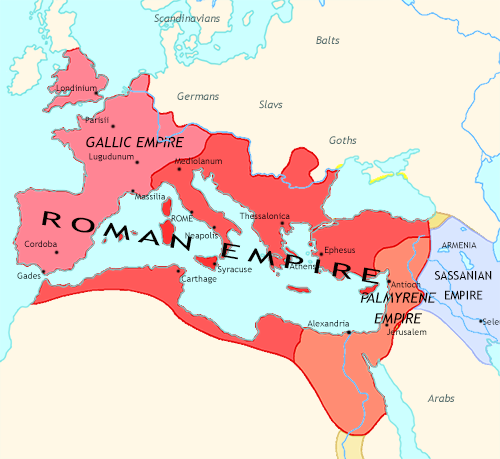
These events triggered half a century of intense crisis. Invasion after invasion broke through the frontier defence cordon and penetrated deep into the heartlands of the empire. One emperor was killed in battle against the Goths (see below), another suffered the humiliation of being captured by the Persians. Emperors were unable to gain the loyalty of the troops – they simply had no time to establish their legitimacy before another revolt swept them away. When a Roman army scored a success against the barbarians, the victorious Roman soldiers often acclaimed their commander emperor, then marched on Rome to set him up as the new emperor. Meanwhile the barbarians had taken advantage of the weakened defences to invade again, and so the cycle continued.
By the 260s the empire looked as if it was breaking apart. Separatist regimes had arisen in the West (the Gallic Empire) and in the east (under the control of the frontier city of Palmyra, in Syria – for many years this would be under a famous queen, called Zenobia).
Viewing this cycle of events which almost led to the end of the Roman story at this time – invasion followed by revolt followed by invasion – historians have debated which was cause, and which was effect. Did the fact that Roman armies were fighting one another encourage the barbarians to invade? Or alternatively, did the invasions encourage revolts by undermining faith in the reigning emperor?
The northern barbarians
The “barbarian” world of central Europe experienced great upheavals during the 3rd century. The German tribes expanded their territory southwards, at the expense of the Sarmatians. In particular, a north German tribe called the Goths migrated from their previous homeland in the Baltic region to a new territory north of the Black Sea.
These upheavals may be linked to the great German invasions of the Roman empire which took place at this time. Another explanation for these is that the Roman armies were so busy fighting amongst themselves and, to do so, stripping the frontier of troops, that it was almost an open invitation for the barbarians to cross into Roman territory. A third explanation is that living close to the Roman frontiers had made the German tribes better armed and better organized then before, so that they were more formidable opponents for the Romans and better able to break through their defences.
What is happening in Imperium: the Rise and Fall of an Empire in 337CE
Soldier-emperors
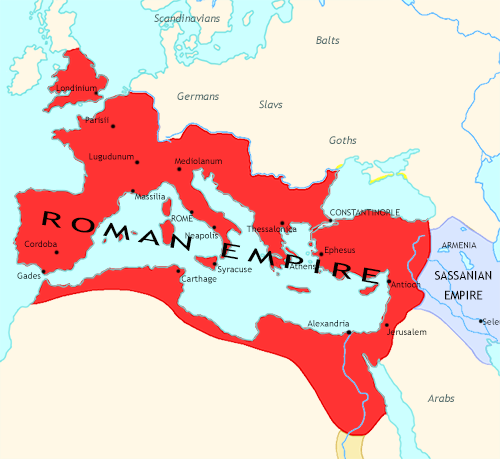
The invasions and instability of the 3rd century inflicted immense damage on the Roman empire. Many cities were sacked, millions of people lost their homes and livelihoods, inflation got out of control, ruining many better-off people. However, the Roman empire survived. A succession of very capable emperors, mostly of Illyrian (Balkan) origin, humble birth and long experience as professional soldiers, used the mobile army based in northern Italy to repulse invasions, overcome rivals and reunify the empire. They went on the offensive against the Sasanians in the east, defeating them on several occasions. The threat from that quarter diminished for some time.
Diocletian
These achievements were consolidated by the emperor Diocletian (reigned 284 to 305). He shored up the frontier defences of the empire and carried through a series of far-reaching reforms to try and ensure that the empire would not go through a similar crisis in the future. Taxes were made heavier to pay for an enlarged army, the bureaucracy was expanded to make government more effective, and the population at large was forced into hereditary classes and occupations so that it could be more closely supervised.
Most famously of all, Diocletian appointed three colleagues to share the burden of rule: four emperors now divided the task of governing the huge empire between them, each ruling a section of it from his own capital (none of which was Rome), and all agreeing to an orderly scheme of succession so as to avoid civil wars. modern scholars call this system the “Tetrarchy”.
Constantine
A few years after Diocletian’s abdication another emperor, Constantine the Great (reign 311-337) carried out still more radical changes. He founded a new imperial capital, Constantinople, at the point were Europe meets Asia. He reformed the coinage around the gold solidus to put an end to the rampant inflation.
Christianity
Most importantly, Constantine proclaimed that henceforth everyone should be free to follow any religion they chose. He thus stopped any further persecution of the Christians. He himself converted to Christianity, and from this time forward, with only a brief break under Julian the Apostate (reigned 361-3), all Roman emperors would be Christians.
After suffering several bouts of persecution, the Christian church suddenly found itself in a radically different position. With the conversion of the emperor Constantine to the faith, Christians were not only free from persecution, but they were favoured by the imperial regime.
Following the emperors’ example, more and more people began to join the Christian church. From this time onwards, other religions started to lose ground in the empire.
The Northern barbarians
To deal with the Germans effectively, the Romans not only used their armies against them. They increasingly settled German tribes within their own territory as allies; and even recruited them into their armies in increasing numbers. Soon some Germans began to rise to senior positions within the Roman army.
The Huns
A people of central Asia called the Huns were to make themselves known to the Romans in no uncertain terms later in the 4th century. However, they would not have appeared from nowhere, and must have been somewhere in central Asia in the generation or so before then, and the region of the Caspian Sea is a reasonable guess.
Many scholars link them to a people in the eastern steppes of central Asia, called the Xiongnu. These people posed a severe threat to the Chinese before the late 3rd century BCE. With the unification of China at that time and the construction of a unified defence system (later known as the “Great Wall of China”) protecting China from the steppes, the theory goes that a group of Xiongnu turned westward, caused immense disruption to the peoples of the steppe and appeared in the vicinity of the Roman empire in the late 4th century CE.
Other scholars deny this link. Whatever the case, the Huns were at this time heading towards the west, where, because of their military effectiveness and brutal ways they would be a potent source of fear to Roman and barbarian alike.
What is happening in Imperium: the Rise and Fall of an Empire in 395CE
The “Barbarian” world
The German tribes were increasingly being disturbed by a new factor – the coming of the Huns.
The Huns’ reputation for cruelty and success in battle preceded them. The desire to escape their looming presence has been cited by some modern scholars as a cause for German tribes to want to push across the frontier into Roman territory.
Whether or not this was the case with other Germans, it was certainly true for the Goths, who stood in the Huns’ path. In 378, desperate to move out of their way before the Huns reached their territory, the Goths sought Roman permission to cross the Danube into the empire. The Romans granted permission somewhat grudgingly, but the officials appointed to supervise the crossing were not up to the task, and treated the Goths arrogantly and insensitively. The Goths rose in rebellion, and massacred the officials. They then headed south, deep into Roman lands. An imperial army under the emperor Valens came to deal with them but was destroyed near the city of Adrianople, and Valens was killed.
The situation was contained by the new emperor, Theodosius, who settled them on Balkan lands within the empire, where they lived peacefully for more than 20 years. However, events then took a turn for the worse, with dire repercussions for the Roman empire.
Imperial government and defence
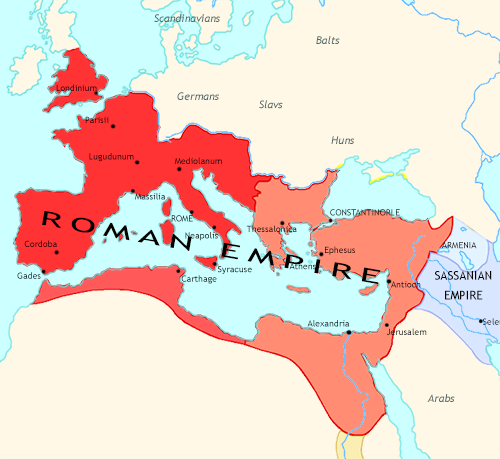
Diocletian’s scheme for an orderly succession between the four emperors, with the two senior emperors abdicating after a period of time and the two junior ones taking their place, soon became a dead letter. However, for the majority of the time there have been two or more emperors ruling at the same time, in more or less harmony. There was no return to the incessant civil warfare of the 3rd century.
The frontiers of the empire were no longer guarded by the legions, but by more numerous and smaller units. However, the main backbone of imperial defence was now the large mobile field armies, which included a large number of heavy cavalry troops (introduced into the Roman military as a direct copy of Persian examples). These field armies were stationed some distance from the frontiers, ready to move up to any trouble spot.
A large proportion of soldiers in these armies were now of barbarian origin. This was true of the officers and commanders as much as the rank and file.
Administration
The rudimentary administrative arrangements of the earlier empire were now replaced with a much larger and more complex bureaucratic machine. Towns and cities no longer ran their own affairs to nearly the extent that they had done earlier; large numbers of imperial officials now supervised them closely. The provinces were much smaller than before, and were grouped together into twelve Vicariates, and these in turn into (usually) four Dioceses. These were headed by some of the topmost officials in the empire.
There were usually two or three imperial capitals at any one time, one of which was always Constantinople; none was now Rome. These capitals thronged with officials staffing the large and complex central ministries of the imperial government, and were centered on a magnificent court. Here, emperors were no longer treated as mere mortals, albeit frighteningly powerful ones; anyone coming into an emperor’s presence had now to bow down on hands and knees before the throne. He was a sacred figure, God’s vice-regent on Earth.
Theodosius was sole emperor when he died in 395, but on his death he divided the empire between his two young sons, Honorius (who was assigned the west) and Arcadius (who took the east). The Roman empire would not be united again until the disappearance of the western empire.
Christianity
Following the emperors’ example, more and more people became Christians, and other religions started to lose ground. Many Christians, rich and poor, began leaving their property to the church, and the church started gaining in wealth. Bishops became the most prominent members of their communities, and the Church soon became the wealthiest institution within the empire.
One reaction against this politicising of Christianity, and the wealth and luxury that went with it, was the choice made by an increasing number of Christians to live a hermit life, far from the temptations of civilized life. This was followed by the growth of communities in isolated locations for Christians who wished to practice their faith in a simple way, free from “worldly” concerns. These communities were the first Christian monasteries, and the start of what would be a hugely influential movement in the Medieval Christian world.
In 381, the emperor Theodosius decreed Christianity to be the official religion of the empire. There would be no more imperial patronage of pagan cults (e.g. financial support in building or repairing temples), and only “orthodox” Christianity (i.e. that version of Christianity most widely accepted by the Christian church, and – crucially – agreed to by the emperor Theodosius) would count as the official state religion. However, this decree did not outlaw other religions, and was not (yet) the signal for the persecution of pagans or “heretical” (i.e. non-orthodox) Christians.
What is happening in Imperium: the Rise and Fall of an Empire in 500CE
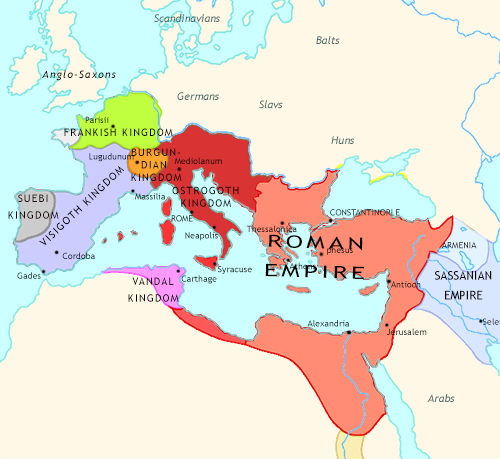
In the 5th century the western Roman empire suffered disaster after disaster at the hands of different German tribes. By the end of the century Roman power in the west had completely vanished.
The disasters of the early 5th century
The Sack of Rome
The division of the empire in 395 left the western half at a disadvantage. The western provinces were poorer than the eastern ones, but with longer frontiers to defend. A smaller tax base had to support a larger army. It is no wonder that it was soon caught up in a series of catastrophic events.
In the early 5th century the restless Goths moved west from their base in the Balkans under their king, Aleric. They marched into Italy, eventually sacking Rome itself (410 CE).
This event sent a shockwave around the Roman world. Although this city had not been the political capital of the empire for more than a century (the capital of the reigning western emperor, Honorius, was Ravenna, in northern Italy), it was still the Eternal City, representing the heart and soul of the Roman people.
Invasions in the north
Meanwhile, in 406, several German tribes had crossed the Rhine frontier en masse. In a confused process which is hard to piece together, some merely occupied territory near the frontier, while others marched great distances, causing devastation on their way. They settled hundreds of miles from their homeland. The Vandals ended up as far away as North Africa.
These German tribes soon established kingdoms. Some of these (the Visigoths and Burgundians, for example) loosely acknowledged the suzerainty of Rome, while others (most notably the Suevi and Vandals) did not.
The loss of Britain
In 410 the Roman army in Britain (probably just the field army stationed there, not the frontier garrisons) was ordered across the Channel to Gaul to defend points closer to the empire’s heartlands. Troubles in Gaul meant that it never returned. The Britons were forced to look to their own defences.
Probably no one realised it at the time, but Britain was now permanently lost to the empire. From the mid-fifth century German peoples, above all the Anglo-Saxons, who were already present in the provinces in some numbers, began the settlement of southern Britain in earnest. In the face of these pagan invaders, literacy, Christianity and city-based life, probably already severely degraded, rapidly vanished.
The Huns
From the late 430s the Huns, having established themselves in eastern Europe and brought many German tribes under their rule, raided the Balkan territories of the Roman empire. They caused immense destruction, leaving large stretches depopulated.
Then, seeking to take advantage of the confusion in the empire to expand their power, the Huns marched westward into Gaul under their leader Attila (451 CE). Such an invasion had been a major fear of both Romans and Germans, but in the event the Huns were defeated by a joint Roman-Visigoth army, under the command of the Roman general Aetius, at the hard-fought battle of Catalaunum (451).
The following year the Huns briefly invaded northern Italy, but then Attila died and the Hun power subsided as rival leaders quarrelled among themselves. Their subject peoples soon threw off Hun rule.
More disasters
The victory of Catalaunium did not stop barbarian immigration. The Roman frontiers along the Rhine and Danube were by now barely operating, and more and more German migrants moved into the empire’s territory unhindered. These years are known in German history as the period of the Great Migrations. Germanic groups already within the empire extended their territories. It was in the 450s and 460s that the Western Roman Empire really ceases to function as a going concern in Gaul and Spain (the Vandals had long since destroyed Roman power in North Africa).
A second sack of Rome
In North Africa, the Vandals built a large fleet and raided the Mediterranean coasts. They subjected Rome to a second sack, in 455. This did not have the same traumatic effect that the first sack, but the damage was a great deal more extensive.
Also, the grain to feed Rome’s huge population had for centuries come largely from North Africa, and this was no longer coming as regularly as before, if at all. As a result, Rome’s population was shrinking fast, though it will remain a large city by the standards of the time for many years to come.
The end of the Roman Empire in the west
In 476 CE, a large group of German mercenaries in the pay of the Roman government (which by this time effectively ruled only Italy and some neighbouring territory) mutinied and succeeded in capturing Ravenna, the seat of the Roman government. Their leader, Odoacer, then brought about the abdication of the Roman emperor, a boy named Romulus Augustulus, and did not replace him.
This event is widely viewed as the end of the Roman empire in the West. Whether contemporaries saw it that way is another matter. It was likely seen as just another incident in a troubled period of time. Even Odoacer himself seems to have seen his actions as simply matching theory to reality. He sent a message to the emperor in Constantinople recognizing that sovereign as his (distant) overlord.
The Ostrogoths
Odoacer himself took the title of king of Italy; although he claimed to be ruling in the name of the Roman emperor in Constantinople, in fact he was entirely independent. A few years later, however (488), the Ostrogoths invaded Italy and established themselves as the ruling group there (they too pretended to owe allegiance to the eastern Roman empire).
The Foundations of Medieval Europe
In the former western provinces of Gaul and Spain, the chaos of the times has gravely disrupted economic life. Gone (or rapidly going) are the great towns, the beautiful villas, the well-built roads, the complex civil service, the well-organized Roman army and the rich intellectual life of the classical world.
In their place, the foundations of early Medieval European civilization are being laid. Towns are much smaller than they used to be; long-distance trade has shrunk; economic activity has shifted to a countryside covered by great estates; much of the peasantry is being reduced to serfdom; and the Christian church dominates the spiritual and intellectual life of the people.
Roman influence is by no means dead here, however. The Latin language is spoken and written by both Romans and Germans, and has begun to morph into French, Italian, Spanish, Portuguese, Catalonian and Provencal. To help them in governing their new kingdoms, the German rulers use Roman administrative institutions and officials. The old Roman populations still live under Roman law.
In short, a group of kingdoms is emerging in the former western Roman provinces (except Britain), in which beginnings of a new society can already be seen. This will eventually evolve into the feudal European world of the Middle Ages.
Religious differences
There has been no real intermingling of the two populations by this date. A major factor which keeps Germans and Romans apart is that most of the Germans, though Christians, follow a form of Christianity called Arianism. The Romans view this as heretical, as Arians do not believe that Jesus was the Son of God, where as Catholics (i.e. Romans) did.
This prevents the Germans from being assimilated into Roman society in the way that, for example, the barbarians who invade China at around the same time are soon absorbed into the Chinese population, and similarly the Huns who invade India are absorbed into Hindu society. The Germans will in due course become Catholics, like the Roman population amongst whom they have settled, but by then Roman civilization will have become severely degraded.
The Eastern Rome Empire
In the eastern Roman empire, life has continued very much as before. Since the division of the empire in 395, taxes collected in the East have been spent in the East. As the eastern provinces were wealthier than the western ones, this means that the eastern treasury is a great deal fuller. Not only are the emperors in Constantinople able to maintain a properly paid army, when needed they are also able to use diplomacy backed up by generous bribes to keep the barbarians out of their territories.
The Theodosian Code
The 5th century has in fact seen one of the landmark achievements of Roman civilization. This is the publication of the Theodosian Code. It was the work of legal scholars working in Constantinople, and was published jointly in Greek and Latin in 439 CE.
This compilation of Roman laws and court decisions will form the basis for the later Code of Justinian in the 6th century, which will in turn influence the entire development of Western law from the Medieval period onwards.
Despite many ups and downs, the eastern Roman Empire would endure for almost another thousand years. Modern scholars call it the Byzantine Empire, to emphasise the differences between it and the old Roman Empire. Although the inhabitants continued to think of themselves as Romans until the very end of their history, they were Greek in language and culture, rather than Latin; they were Greek Orthodox Christian in religion; and they were ruled from Constantinople instead of Rome.
 What else is happening in the rest of the world...
 What else is happening in the rest of the world...
Greece and the Balkans history 200BCE
The golden age of the Greek city-states gives way to an era dominated by Alexander the Great and his successors

Italy history 200BCE
The cities and tribes of central and southern Italy have come under the firm leadership of Rome

France history 200BCE
The area of modern France is now dominated by the Celtic La Tene culture

Spain and Portugal history 200BCE
Carthaginian and Roman armies have contested much of Spain

Subscribe for more great content – and remove ads