

The Foundation of the Ming Dynasty
The Ming dynasty is notable for being a native Chinese dynasty sandwiched between two foreign dynasties, the Mongol and the Manchu.
The Mongols had ruled the whole of China since the reign of Kublai Khan (reigned 1279-1294). Kublai governed more as a Chinese emperor than a Mongol khan, and brought China a high degree of internal peace and prosperity. After him, however, standards of Mongol government declined. This ultimately led to massive revolts breaking out, and to the Mongols being driven out of China back into central Asia (in 1368).
The leader of the revolt against the Mongols, Zhu Yuanzhang, founded a new Chinese dynasty, the Ming. He reigned as the Hongwu emperor (1368-98).
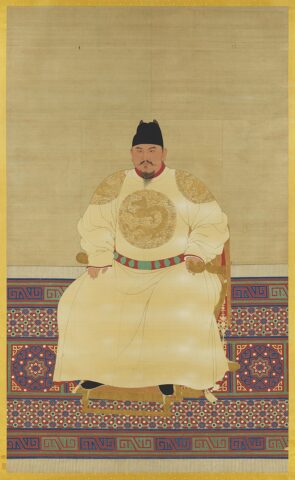
The Hongwu Emperor – unknown artist
The new emperor chose the city of Nanjing, in southern China, as his capital. He was succeeded by his grandson, a young man of 21. Just a year later, however, he was faced with a rebellion by his uncle, who after a brief but brutal civil war seized the throne to become the third Ming emperor (the Yongle emperor, reigned 1402-1424).
The early Ming emperors were able rulers. Not only did they secure the empire’s borders, but internally they brought standards of government up to par after a decline under the Mongols. They re-established Confucianism as the official ideology of government, and reinvigorated the civil service by restoring the government examination system to its former central position in the state.
The Yongle Emperor
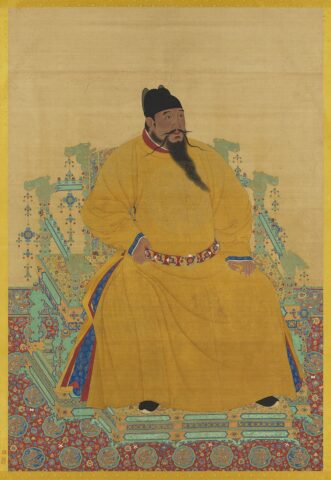
The Yongle Emperor
The Yongle emperor was an ambitious and vigorous ruler. He shifted the capital from Nanjing to Beijing, the better to keep an eye on the continuing threat from the Mongols. He ordered the construction of the great imperial palace complex known as the Forbidden City, which still today lies at the heart of the Chinese capital. It is the world’s largest palace, and a UNESCO World Heritage site.
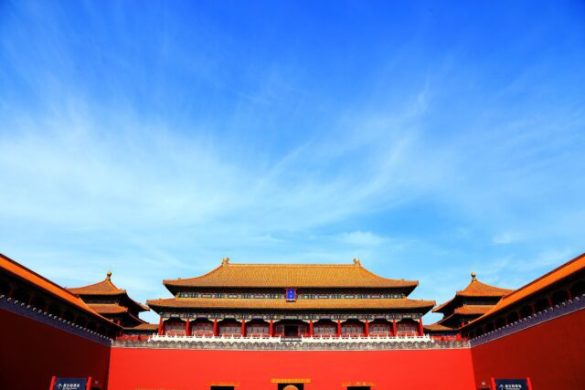
The front gate (Meridian Gate) of the Forbidden City, Beijing
The Yongle emperor’s reign is also famous for a remarkable series of seven voyages into the Indian Ocean. These eventually took Chinese fleets as far as the African coast. They were commanded by the most notable of all Chinese admirals, Zheng He. Some consisted of more than a hundred vessels, and were crewed by thousands of men. At their heart lay the enormous treasure ships, undoubtedly the largest vessels in the world at that time and which put contemporary European ships into the shade.
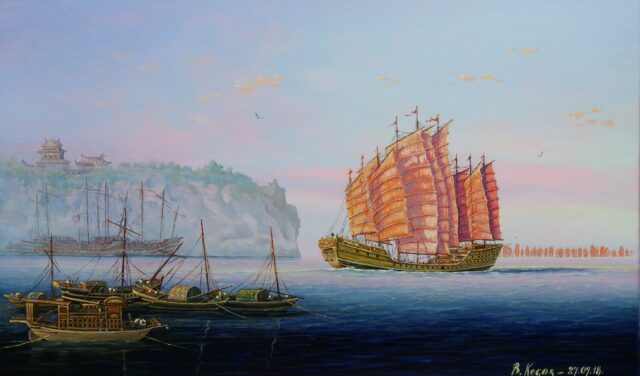
A painting of ships of the Ming treasure fleet (Vldamir Kosov: Creative Commons Licence)
These voyages built on the experience and achievements of Chinese navigators, sailors and shipbuilders from the Tang and Song periods onwards, and marked the high point of Chinese seafaring in pre-modern times. After Yongle’s death, however, the Chinese court lost interest in promoting overseas voyages, presumably due to their expense, coupled with the growing need to focus on the renewed threat from the central Asia.
The Great Wall of China
Although the Chinese had succeeded in driving the Mongols out of their country in the 14th century, they had not been able to land a decisive blow to their power on the steppes. After a generation or so following their expulsion from China, new leaders emerged who were set on re-establishing Mongol rule in China.
A series of wars followed, in which the Chinese struggled to defeat Mongol forces. The low point came when, in 1449, an imperial army on an expedition into Mongol territory – accompanied, unusually, by the emperor, the young Yingzong – was ambushed. The emperor was captured, though released by the Mongols a year later. (In the meantime, a new emperor, Jingtai, had come to the throne. Yingzong, seen as a threat, was imprisoned, but then was restored to the throne when his . However Jingtai shortly fell ill, and later died, and Yingzong was restored to the throne.)
This humiliating disaster led the Ming regime to rebuild the ancient Great Wall of China, a monumental task involving the construction of defensive systems more than 4000 miles long. This was a huge undertaking, which took several ecades to complete, during the later 15th and early 16th centuries. The danger from the Mongols declined from the 16th century, after a string of victories by the Ming army.
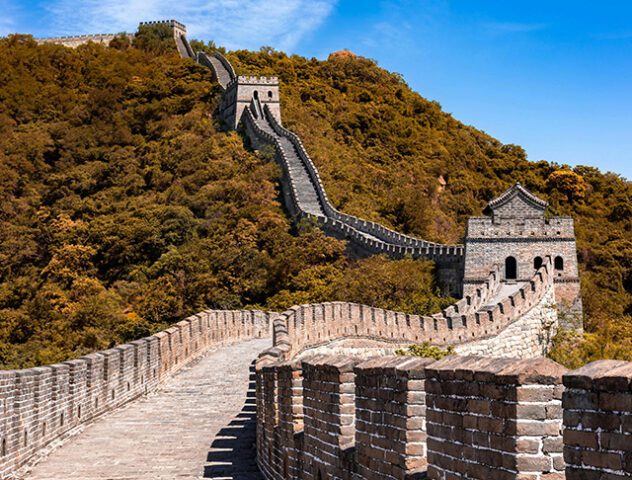
The Great Wall of China crossing mountainous terrain (Public Domain)
Diplomacy, trade – and Europeans
Under the Ming, the huge country enjoyed a prolonged period of peace. Beyond its frontiers, Ming China was held in awe by other East Asian countries. The rulers of Korea, Myanmar, Siam, and Nam Viet (northern Vietnam) acknowledge Ming overlordship, and sent regular tribute missions to the imperial court. This was the famed tribute system centred in China which flourished in the later dynasties of Chinese history. At times tribute was received from as far afield as Java and Sumatra, Sri Lanka and South India, and even the Middle East.
Apart from the Mongols, of China’s neighbours only the Japanese did not send tribute missions. On the contrary, Japanese (together with renegade Chinese) pirates plagued the southern coasts of China. This upsurge in piracy was linked to the Ming government’s attempt to enforce a prohibition on private trade with foreigners. In this, all ports had to cease international trade except Guangzhou. This threatened a huge number of sailors and other workers linked to seaborne traffic with destitution, so it is little wonder that many of them became outlaws and sea brigands.
The pirates were eventually deterred by the establishment of a defensive system of coastal forts and flotillas of warships to protect the coast.
Included in this development were early European traders to China. The Portuguese were able to establish a trading settlement at Macau, near to Guanghzhou, in 1557, but many Portuguese, as well as Spaniards and Dutch adventurers, took to smuggling and piracy as a lucrative alternative to legitimate trade. The attitudes of Ming (and later) officialdom towards Westerners as rough-necked barbarians was shaped by this experience.
Suspicion of Europeans hampered Christian missions to China. However, the Jesuits were able to establish missions in various cities from the 1580s, and even gained the protection of the imperial court. As much as for their religious message, they were appreciated for the European science and technology that they introduced to the Chinese. This included the manufacture of western cannons, which were superior to Chinese ones and were introduced into the Ming army. The westerners’ more accurate astronomy also made a deep impression on the Chinese, with their intense interest in the heavens.
Decline….
After Yongle’s reign, the Ming throne was generally occupied by young and inexperienced emperors. They increasingly relied on their close attendants, the palace eunuchs, for support and counsel. Tensions between the eunuchs and the senior civil servants, who were kept at a distance from the person of the emperor, mounted, and caused increasing instability at court.
The long reign of the Jiajing emperor (reigned 1521-1567) saw a significant downward step in standards of government. He spent much of his reign in bitter conflict with the leaders of the civil service. Factionalism and corruption, both at court and in the provinces, was allowed to grow unchecked. A little later, during another long reign, that of the Wanli emperor (reigned 1572 – 1620), matters deteriorated still further. The fact that this emperor virtually withdrew from government for several years only made things worse.
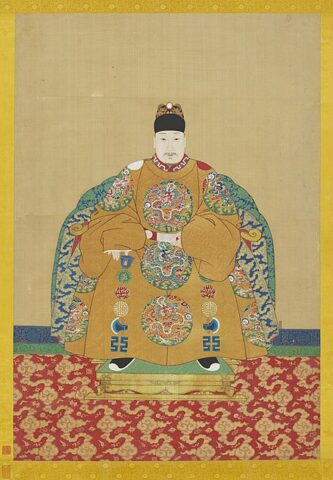
The Wanli Emperor
Deep rancour grew up between the the civil service and the all-powerful eunuchs, who regularly had senior ministers humiliated, tortured and executed. The infighting at court not only undermined sound policy-making, but allowed the administration of the provinces to become more and more corrupt and oppressive.
A long and cripplingly expensive war in support of the Koreans against the Japanese (1592-8), drained the treasury and weakened the government. By the early 17th century, brutal factional struggles at court were undermining what remained of good government. From 1624, power fell into the hands of one of the most notorious figures in all Chinese history, the eunuch Wei Zhongxian. Wei had hundreds of court officials executed, and filled all high posts with his friends, regardless of how competent they were.
In these circumstances little attention was paid to a growing threat from beyond China’s borders, from a group called the Manchus. In the early 17th century they had begun pressing on the Ming defences on their northeastern borders.
…and Fall
The Ming court had other more pressing matters on their hands, however. As had happened on frequent occasions before, oppressive government led to massive peasant rebellions breaking out. One of these succeeded in taking the capital. In despair, the last of the Ming emperors, the Chongzhen Emperor, hung himself in the palace garden.
Meanwhile the general commanding the Ming forces guarding the Great Wall to the east of Beijing, Wu Sangui, had called on the Manchus for support in retaking Beijing. The Manchus were only too pleased to help. The joint Ming-Manchu army marched on the capital, and in the face of this new threat the peasant rabble withdrew from the city, after sustained looting.
The Manchus occupied the city, but instead of delivering it back to the Ming they proclaimed their own dynasty (the . They called it the Qing, which means “Brilliant”. (Wu Sangui was rewarded for his support by being given a huge territory to govern in southern China).
Surviving members of the Ming royal family led (or were figureheads of) resistance to the Manchu in various parts of southern China. The last of these was finally eliminated in 1662.