
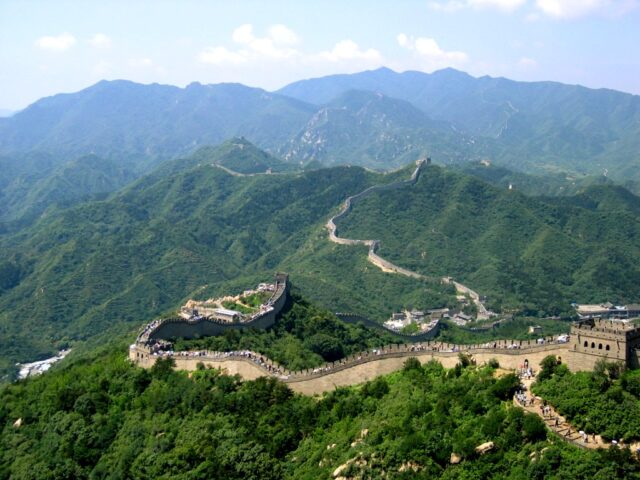
The largest structure ever built is (if you hadn’t already guessed it) the Great Wall of China. At 8,850 km (5,500 miles) long from east to west, or nearer 13,000 miles if all the various parallel defence system are take into account, nothing else comes close.
And when we think of a very valuable piece of ceramics, we often think of Ming Vases.
And that gives a clue as to what connects them: both these artefacts date from the Ming dynasty.
The Great Wall of China is often credited to the First Emperor, Qin Shih Huang, who reigned 1500 years before the Ming dynasty. However, the wall we see today was almost all built in the 15th century, when the Ming dynasty ruled China.
As for Ming vases, these are today the quintessential high value porcelain vases that we see in museums or hear about going for enormous prices at art auctions. Why are they so expensive? It’s because the techniques of ceramic making reached their maturity during the Ming dynasty. And while the Qing dynasty, which followed the Ming, continued (and indeed improved on) the ceramic traditions of their predecessors, much of the output from Chinese factories in Qing times was mass produced, aimed at the foreign (i.e European and American) market. Although this included some of the finest porcelain pieces ever produced, the majority of the ceramics were of a lower level of quality than surviving Ming vases. Also, their sheer quantity meant that they were not as highly prized as their Ming predecessors.

Vase from the middle period of the Ming Dynasty – Public Domain Image
So, you probably know a bit about the Great Wall of China, and you’ve almost certainly heard of Ming vases – but what do you know about the Ming dynasty itself?
You might even be asking, did such a dynasty as the Ming even really exist, and not denote a fantasy figure such as Ming the Merciless, or the Mighty Ming?
Well, the Ming dynasty did indeed exist. And here are some facts about it.
The last native dynasty of imperial China
So what key things are there to know about the the Ming dynasty?
- The first (and probably most important for the Chinese themselves) is that it was the last native dynasty to rule imperial China. To be more precise, it was sandwiched between two foreign dynasties, the Mongol (or Yuan) dynasty (1271-1368) and the Manchu (or Qing) dynasty (1644-1912). The Ming dynasty came to power when the Mongols were finally expelled from China in 1368, after a decades-long rebellion against them. The founder of the dynasty, the Hongwu emperor, had been the leader of that rebellion.

Map of Ming China, mid-15th century – Timemaps
- A second key point is that the Great Wall of China is not the only majestic monument to come from that dynasty. Most of today’s Forbidden City in Beijing, the world’s largest palace complex, dates from that period.
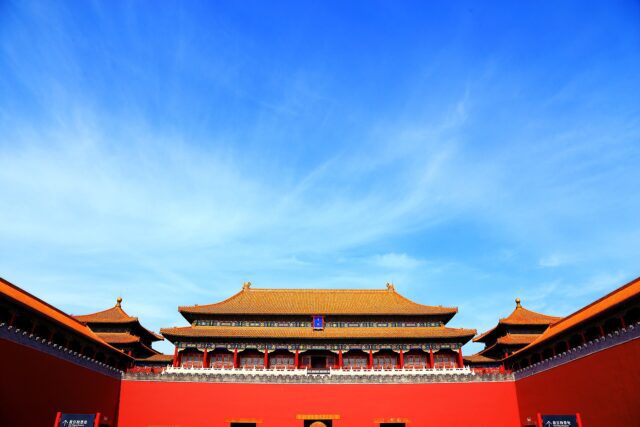
The front gate (Meridian Gate) of the Forbidden City – Public Domain Image
- Thirdly, at about the same time that the Forbidden City was being built, the Chinese were launching by far the largest voyages of exploration that the world had seen up to that point. The Polynesians may have sailed further, but the sheer scale of the Ming expeditions was almost unbelievable. The fleets that undertook these voyages were made up of hundreds of ships, and they travelled as far as the east coast of Africa.
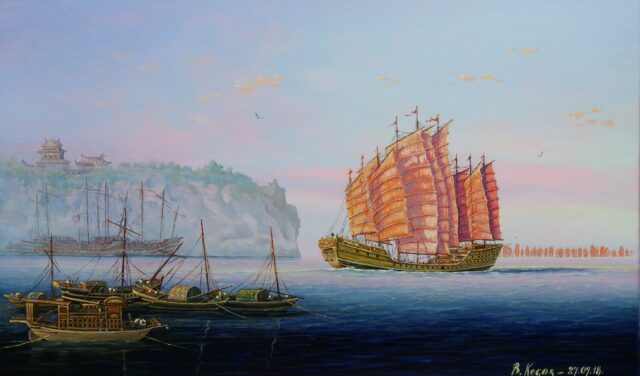
One of the ships on the Ming treasure fleets (Vladimir Kosov: Creative Commons Licence)
- Fourth, although the Ming regime presided over a long period of internal peace in China, its politics were terrifying. The story goes that, each day as they went to work, senior court officials would bid their wives farewell, not knowing whether they would be alive at the end of the day.
- The final point is that the Ming dynasty succumbed to an invasion of foreigners – the Manchus – who ironically came from beyond the Great Wall. But a Ming general had invited the Manchu forces in, to help him deal with rebellious peasant forces who had occupied the capital. The Manchu came, but they didn’t leave!
You can find out more about this iconic dynasty by following this link to the Timemaps article on the Ming dynasty.
To find out more about why Ming vases are so costly, follow this link.