
South East Asia 30 BCE




What is happening in South East Asia in 30BCE
Civilization and the Pye kingdom
The first literate and urban civilization of South East Asia has now appeared, in Burma. This is linked to the Pye kingdom, which, lying across the trade routes between China and India which pass down the Irrawaddy river system to the Indian Ocean, has received influences from both these great civilizations. The kingdom seems to be a confederacy of small states under a royal overlord based in the city of Pyu. According to Chinese records, the Pye culture is strongly Buddhist by religion, and is noted for its emphasis on humane values.
Next map, South East Asia in 200 CE
Dig Deeper
Ancient East and South-East Asia
Civilization: Origins and Development
The Classical period of Ancient India (700-350 BCE) – Impact on SE Asia
Premium Units
What is happening in South East Asia in 3500BCE
Stone Age farming
South East Asia is home to some of the oldest agriculture in the world, with small Stone Age farming communities growing millet, beans and yams, and keeping chickens, pigs and water buffalo.
Hunter-gatherers
These farming societies are few and isolated, however. Most of South East Asia is inhabited by hunter-gatherer peoples, making their homes in the dense forests which cover much of the landscape.
Next map, South East Asia in 2500 BCE
Dig Deeper
Ancient East and South-East Asia
Premium unit
What is happening in South East Asia in 2500BCE
Population movements
At around this time, a series of major population movements begin to affect this region. Starting in southern China and Taiwan, farming and fishing communities begin to move south and west, into the coasts and islands of South East Asia. These are the ancestors of today’s Malays, Polynesians and other Austronesian peoples, and it is the start of a millennia-long migration which will take them to Madagascar in one direction, and Hawaii in the other.
Spread of wet-rice farming
At the same time, the population of south west China is expanding as Austroasiatic migrants move in from the central Yangtze valley, with their wet-rice farming technology. From there they will soon begin to follow the river valleys down into present-day Burma and Laos.
Next map, South East Asia in 1500 BCE
Dig Deeper
Ancient East and South-East Asia
Premium unit
What is happening in South East Asia in 1500BCE
Expansion
By this date Austronesians are settling the coast and islands of the Philippines, as well as points further east, into the Pacific, and south, towards New Guinea. They are sailors and fishermen, and have developed advanced boat-building and navigation techniques.
Rice farmers
Meanwhile, continued population expansion in southern China is leading Austroasiatic-speaking peoples to migrate from there into northern South East Asia. They bring with them their wet-rice farming techniques, pioneered by their ancestors in the Yangtze Valley, and this allows their numbers to grow. Their rice-farming villages soon dot the rivers and valleys of present-day Burma and Laos. Their descendants, notably the Mon and Khmer peoples, will come to form a major part of the population of mainland South East Asia.
Next map, South East Asia in 1000 BCE
Dig Deeper
Ancient East and South-East Asia
Premium unit
What is happening in South East Asia in 1000BCE
Populations movements
This region continues to witness movements of populations. The Austronesians have established themselves on the coasts and islands of the Philippines, and are now probing outwards to the coasts of Vietnam and Borneo, as well as south-eastwards along the coast of New Guinea and into the Pacific.
The use of bronze
In the west, the Austroasiatic ancestors of the Mon and Khmer peoples are continuing to spread downwards in South East Asia, establishing their rice-growing villages as they go. The use of bronze for weapons and decorative objects is also now becoming established among these peoples, as a result of continuing links with southern China.
Burma
To the north, a new group of peoples, the Tibeto-Burmans, are moving down the river valleys of south-east China into northern Burma.
Next map, South East Asia in 500 BCE
Dig Deeper
Ancient East and South-East Asia
Cities and the Emergence of Civilization
Civilization: Origins and Development
Premium Units
What is happening in South East Asia in 500BCE
Austronesians
The Austronesians have, over the past few centuries, been thrusting westwards into the coasts and islands of South East Asia. Here, they will become known as the Champa, the Malays, and the Javanese.
Burmans
In the north, the Burmans (including the Pye) are establishing themselves in northern Burma, pushing the Mon and Khmer peoples south and east.
The coming of iron
By this date, the use of iron, for weapons and farming implements, is spreading down into South East Asia from southern China.
Next map, South East Asia in 200 BCE
Dig Deeper
Cities and the Emergence of Civilization
Civilization: Origins and Development
Ancient East and South-East Asia
Premium Units
What is happening in South East Asia in 200BCE
Contacts with India
The coasts of Burma and the Malayan peninsula are by this date already being visited by sailors and traders from the Indian sub-continent, and by Hindu and Buddhist missionaries. These religions, together with the cultural package that they bring with them, including literacy (in Sanskrit), and Indian styles of art and architecture, are beginning to make headway in the region. Small kingdoms have probably already begun to appear along these coastlines, outposts of Indian civilization.
Next map, South East Asia in 30 BCE
Dig Deeper
Ancient East and South-East Asia
Civilization: Origins and Development
The Classical period of Ancient India (700-350 BCE) – Impact on SE Asia
Premium Units
Early Civilization 700-500 BCE
What is happening in South East Asia in 200CE
Burma
The Pye kingdom continues to flourish, and it is likely that the broad outlines of later Burmese civilization are already being laid down, with its Buddhist foundations and emphasis on monasticism, expressed architecturally in the distinctive vaulted temples which adorned later Burmese cities.
Indian civilization
Elsewhere in South East Asia, it is Hinduism that is most influential at this time. Indian traders have established stopping-off points along the coast, around which local rulers have established small states, deeply influenced by Indian civilization. The most notable of these states is the kingdom of Funan.
The Tai people
In southern China, increasing numbers of Chinese settlers from the north are putting pressure on local tribes. Most notably, the Tai (or Thai) people are gradually beginning to move away from their original homeland into the border areas between China and South East Asia.
Next map, South East Asia in 500 CE
Dig Deeper
The Deccan Empires – section on economy
Premium Units
What is happening in South East Asia in 500CE
Indian influences
At this stage in its history the region’s strong trading and cultural links with India are at their height. Buddhism has gained a firm foothold in Burma, and Hinduism is a major cultural force throughout much of the rest of South East Asia. With these faiths has come Indian influences in art, architecture and political organization.
In present-day Vietnam, an area formerly full of “wild tribes” has been moulded into a kingdom by leaders of Chinese origin. Like Funan, to the south, it is organized along Indian lines, as are the numerous small kingdoms on the Malayan peninsula, eastern Sumatra and eastern Java.
Mon expansion
In northern South East Asia, Mon tribes are expanding in modern-day southern Burma and northern Thailand. This movement may be linked to the drift of Tai (Thai) tribes southwards into Laos and northern Thailand.
Next map, South East Asia in 750 CE
Dig Deeper
The Deccan Empires – section on economy
Premium Units
What is happening in South East Asia in 750CE
Chinese influence
By this period, Chinese influence is growing in South East Asia. Under the powerful Tang dynasty, China’s trade with the countries of the region is expanding strongly, and one consequence of this may well be the rise of the maritime power of Sri Vijaya, which seems to enjoy a specially-favored status as a tributary trading partner with the Chinese empire. This state controls the trade routes between China and India.
The Champa kingdom
The Champa kingdom remains a thriving center for trade, though further south the centuries-old kingdom of Funan has disappeared.
Pye and Mon kingdoms
Another long-established South East Asian state, the Pye kingdom in Burma, is coming under increasing pressure from Burman tribes from the north. Meanwhile, the Mon people have established powerful kingdoms in southern Burma and northern and central Thailand.
Next map, South East Asia in 979 CE
Dig Deeper
The Deccan Empires – section on economy
Philosophy, religion and culture in medieval China
Premium Unit
World Trade in the Medieval Period – 750
What is happening in South East Asia in 979CE
Burma
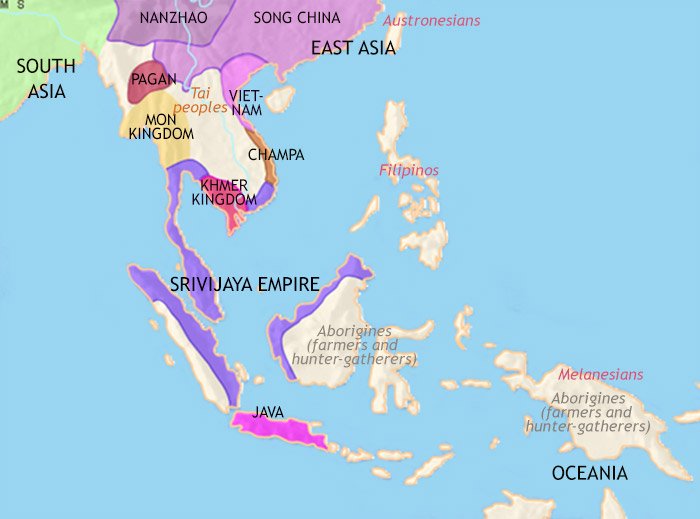
In Burma, the kingdom of Pyu has fallen. In its place, the Burmans have founded a state based on their capital Pagan, while a powerful Mon kingdom has also been established. Both the Mon and Pagan kingdoms have inherited much of their civilization from the Pyu kingdom, and both give Buddhism a central place in their religious and cultural life.
Champa, Vietnam, Khmer
This period sees Champa reach a peak of power and prosperity, and to its north, the Vietnamese people, hitherto content to remain under Chinese rule, have won their independence. In Cambodia, a strong, centralized Khmer kingdom has superseded the numerous smaller states in the area.
Sri Vijaya and Java
The Sri Vijayan empire continues to dominate many of the coasts and islands of South East Asia. However, the kingdoms of Java have won their independence. Here, one of the most remarkable structures in the entire region has been constructed, the massive Buddhist temple complex at Borobodur.
Next map, South East Asia in 1215
Dig Deeper
The Deccan Empires – section on economy
Premium Unit
World Trade in the Medieval Period – 979
What is happening in South East Asia in 1215CE
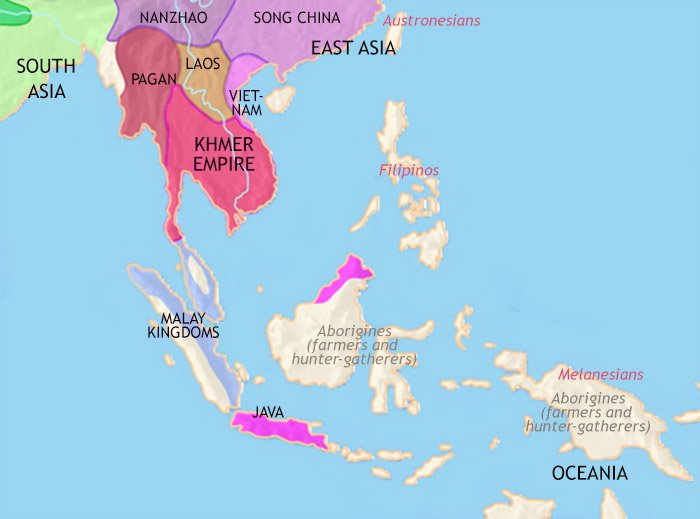
Malay kingdoms
The Sri Vijaya empire has vanished, to be replaced by numerous kingdoms in Malaya, Java and Sumatra.
The Khmer empire
The dominant power in the region is now the Khmer empire, which is based in Cambodia but has conquered the historic kingdom of Champa and has expanded over a huge empire. This is the age in which the great series of Khmer temples were built, culminating in Angkor Wat, by all measures one of the most spectacular buildings ever constructed anywhere in the world.
Burma
In Burma, the Burman kingdom of Pagan has now expanded, conquering the Mon kingdom to the south.
Next map, South East Asia in 1453
Dig Deeper
The Deccan Empires – section on economy
Premium Unit
What is happening in South East Asia in 1453CE
Mongol attacks
The Mongol empire launched powerful attacks into Vietnam, Burma, Java; despite inflicting much destruction, however, they failed to hold much territory.
Thai dominance
For some centuries now, Thai tribes have been moving into northern South East Asia, from their homeland in southern China. These incomers have been a large cause of the steep decline of the Khmer empire, and the Thai kingdom of Siam is now the dominant state in that area. With these political changes has come a rise in the influence of Buddhism.
Muslim sultanates
To the south, in a development of the utmost importance for future history, Muslim merchants from Arabia and India have established a network of small sultanates along the coasts and in the islands of the region.
Next map, South East Asia in 1648
Dig Deeper
The Islamic Caliphate:section on decline and spread
Premium Unit
What is happening in South East Asia in 1648CE
Burma and Siam
On the mainland of South East Asia, Burma briefly conquered Siam and other neighboring countries in the late 16th century. These conquests were short lived, and the Siamese have resumed both their independence and their regional dominance.
Malay sultanates and European pressures
On the islands and coasts of the region, the numerous small Muslim sultanates have become home to a far-flung Malay culture, knit together by a shared religion and maritime trade. However, a new political and commercial presence has appeared in the form of European sailors, traders, soldiers and missionaries. First the Portuguese, and then the Dutch, through the Dutch East India Company, have seized a handful of coastal bases, from which their seaborne trade is expanding. The Philippine islands, too, have been partially colonized by Spain.
Next map, South East Asia in 1789
Dig Deeper
Premium Unit
What is happening in South East Asia in 1789CE
Thailand
Burma again conquered Siam, in 1767, but within a decade the Thais regained their kingdom. Since then, a new dynasty has come to rule Thailand (and has held the throne up to the present day), with its capital at Bangkok. Thailand has gone on to expand its power at the expanse of its neighbors, Laos and Cambodia.
Vietnam
Vietnam has expanded southwards, to more or less its present-day boundaries. However, the country is now torn by a vicious civil war, between north and south.
The south
To the south, the Dutch, through the Dutch East India Company, have extended the control over Java, with their commercial influence spreading throughout the Indonesian islands. A new power, the British, have entered the region with the acquisition of Penang Island, off the west coast of the Malayan peninsula.
Next map, South East Asia in 1837
Dig Deeper
What is happening in South East Asia in 1837CE
Vietnam and Cambodia
Vietnam has been reunited. Cambodia has been the scene of fighting between Thailand and Vietnam, and has been see-sawing between control by the two opposing countries. The period ends with Thailand in control.
British acquisitions
To the south, a British adventurer, Sir Stamford Raffles, occupied the sparsely populated islands of Singapore in 1819. It soon becomes a bustling trading town. A few years later the British acquired Malacca from the Dutch (1824).
Dutch possessions
In the Dutch East Indies, meanwhile, the Dutch government has taken over from the Dutch East India Company in governing their overseas possessions here.
Next map, South East Asia in 1871
Dig Deeper
What is happening in South East Asia in 1871CE
Increasing European power
Over the past few decades, European power has become much more in evidence in South East Asia. The Dutch have established their domination throughout the Indonesian archipelago, though they as yet do not directly control some of the islands. In Vietnam, the French have conquered much of the south of the country. Thailand, whilst retaining its borders largely intact, has had to give up much of its independence in a series of unequal treaties with western powers.
Chinese migration
In another development of great importance to the region, thousands of Chinese have poured into South East Asia from their troubled homeland, settling mainly in the British-controlled Malay peninsula (especially the commercial center of Singapore), and the Indonesian islands.
Next map, South East Asia in 1914
Dig Deeper
What is happening in South East Asia in 1914CE
Western empire building
The past few decades have seen Western powers virtually sharing out the lands of South East Asia amongst themselves. The British now rule the whole of the Malay peninsula and much of northern Borneo. The Dutch have secured direct control over all the Indonesian islands. Laos, Cambodia and Vietnam are all grouped together within French Indo-China. Only Thailand stands out as the exception: it has lost some border provinces to France and Britain, but otherwise remains intact. Internally, the country is carrying out a comprehensive modernization program.
The Philippines
The Philippines have passed from Spanish to US rule as a result of a short war (1898). Having secured the colony after a widespread revolt, the USA sets about introducing modern democratic institutions, as well as modernizing its economy.
Chinese and Indian immigration
Throughout this period, millions of Chinese continue to settle in the towns of the Malay peninsula and Borneo. At the same time the British bring in thousands of Indians to work on the plantations.
Next map, South East Asia in 1960
Dig Deeper
What is happening in South East Asia in 1960CE
Occupation
This region has experienced a huge amount of upheaval over the past few decades. Colonial rule by the European powers and the USA lasted intact until World War 2. Then, the Japanese occupied most of South East Asia, and many areas saw fierce fighting between the Allies and the Japanese.
Independence
After the war, European efforts to re-establish control over their colonies failed. Indonesia became independent from the Dutch in 1949, and nationalist insurrections in French Indochina led to Cambodia and Laos being granted independence by France in 1949, and Vietnam being divided between the communist North and anti-communist South (1954). The British gave Burma independence in 1948, and after putting down a major communist insurgency, Malaya in 1957. Singapore became a British crown colony in 1959, with self rule. The Philippines had been granted self-government by the USA in 1934, but full independence had to wait until until 1946, after the Japanese occupation during World War 2.
Next map, South East Asia in 2005
Dig Deeper
What is happening in South East Asia in 2005CE
Vietnam
A long war between the communist North Vietnam and anti-communist South Vietnam broke out in the early 1960s, and soon drew in the USA and some other countries, as well as Vietnam’s neighbors Cambodia and Laos. The USA eventually withdrew its forces (1973) and two years later North Vietnamese forces reunited the country. By this time one of the most brutal regimes in world history, the Khmer Rouge, had come to power in Cambodia, inflicting large-scale massacres on the population.
Asian Tigers
Since the 1980s, several South East Asian countries, especially Singapore, Malaysia, Indonesia, Thailand and Vietnam, have experienced dramatic economic growth, which gave the them nickname “Asian Tigers”. This has been accompanied by the wide-scale adoption of multi-party democracy in the region (though not everywhere, for example in communist Vietnam). The Asian Financial Crisis of 1997 threatened to bring economic progress to a halt, but within a very short time growth had returned.
Myanmar (Burma)
The outstanding exception to all these developments is Burma, now called Myanmar, which remains under the tight control of an authoritarian military regime.
Dig Deeper

Subscribe for more great content – and remove ads