
Europe 500 BCE


What is happening in Europe in 500BCE
This map shows the history of Europe in 500 BCE. The Iron Age has spread throughout the region, and has given rise to the brilliant civilization of the Ancient Greeks.
Iron Age Europe
Over the last few centuries the coming of the Iron Age to Europe has led to a large growth in populations throughout the continent, as well as great advances in culture.
Civilizing influences from the Middle East began again to be felt by the peoples of south-eastern Europe in the centuries after 1000 BCE. Phoenician merchants developed new trading networks across the Mediterranean Sea. They brought with them knowledge of the great civilizations of Mesopotamia and Egypt – and also an important new tool, alphabetic writing.
A brilliant new civilization
On the coasts and islands of the Mediterranean Sea – of Greece and the Aegean, Italy and Sicily, the southern coasts of France and Spain, and north Africa – hundreds of city-states now flourish. The driving force behind this is the colonising activities of the Greeks.
The emergence of the Classical city-state in the Mediterranean world has allowed one of the most brilliant civilizations in all human history to develop, that of ancient Greece.
Most have rejected their old tribal kings and adopted a republican style of government. They provide a fruitful environment for advances in many branches of endeavour: artistic, intellectual and political.
This form of government is now spreading to other peoples in the Mediterranean region: it is about now that the small city of Rome, in central Italy, ejects its kings and becomes a republic.
In the north
To the north, the Celts now cover western Europe from Spain in the west to Britain in the north. Peoples closely related to them, both ethnically and culturally, dominate central Europe.
Related Timemap
Imperium: The Rise and Fall of the Roman Empire: A sequence of maps tracing the rise and fall of the Roman Empire, from the start of the Republic (c. 500 BCE) to the fall of the Western Roman Empire (500 CE).
Dig Deeper
Ancient Greece: history of a civilization
Premium Units
World Trade Classical Era: 500 BC
Sources:
What is happening in Europe in 3500BCE
For the past two thousand years or so, farming has slowly been spreading throughout Europe, and now covers most of the continent. People live in small village communities, mostly practicing a mixed economy of agriculture together with hunting and gathering. To the north, hunting and gathering predominate.
Dig Deeper
Premium unit
The Origins and Spread of Farming
What is happening in Europe in 2500BCE
The previous centuries have seen nomadic peoples from the central Asian steppes, speaking Indo-European languages, coming into eastern and central Europe. Their domestication of horses has given them a military edge, and they seem to have imposed themselves upon the earlier populations as a ruling class.
Material progress has continued for the past thousand years. Long-range trade networks are becoming established throughout the continent, and linking Europe to the Middle East. Copper is coming into use, starting in southern Europe and spreading into eastern and central areas of the continent.
Dig Deeper
Early Pastoralists: See section on The Indo-Europeans
Premium unit
What is happening in Europe in 1500BCE
This map shows what is happening in the history of Europe in 1500 BCE.
Bronze Age cultures
Over the past thousand years Europe has become coverd by a network of Bronze Age farming cultures, ruled for the most part by powerful chiefs and warrior elites. Much of eastern and central Europe is home to Indo-European speakers, ancestors of the Celts, Germans, Italians and Illyrians.
The Minoan civilization
In the south east corner of the continent, in Greece, an important development in world history has taken place. Civilization has arrived from the Middle East, with its already ancient cities and empires, by way of the Aegean. First the Minoan civilization of Crete appeared, then the Mycenaean civilization of Greece.
Dig Deeper
Ancient Greece: history of a civilization
Early Pastoralists: See section on The Indo-Europeans
Premium unit
Trade in the Ancient world 1500 BCE
The Origins and Spread of Farming
Sources:
What is happening in Europe in 1000BCE
This map shows the history of Europe in 1000 BCE.
A period of turmoil
Over the past few centuries the peoples of Europe have experienced widespread disruption as the peoples of the Tumulus cultures have expanded out from their central Europe homelands, just before 1200 BCE. The train of migrations and invasions this set in motion has had a huge impact on the wider world. It probably caused the fall of the first literate civilization on the European mainland, that of the Mycenaeans, and led to the violent eruption of the “Sea Peoples” from southern Europe into Middle Eastern history.
Within Europe itself, the peoples of the old Tumulus cultures are now distributed around western, central and southern parts of the continent. Over the next few centuries they will become Celts, Germans, Slavs and Italians.
Dig Deeper
Ancient Greece: history of a civilization
Premium unit
Early Civilizations 1300 BCE – 1000 BCE
Trade in the Ancient world 1000 BCE
Sources:
What is happening in Europe in 200BCE
The map shows the history of Europe in 200 BCE. In the eastern Mediterranean, the Greek city-states have experienced a glorious period of cultural progress, but also of intense in-fighting. In the western Mediterranean there is a new power on the rise, Rome.
The Greeks
In the Mediterranean world, the huge Persian Empire made a major attempt to conquer the city-states of Greece. This the Greeks successfully resisted. Then, under the leadership of the city of Athens, they went on to register immense achievements in all fields of culture. Above all, Greek philosophers such as Socrates, Plato and Aristotle have laid many of the foundations for later Western thought.
By 200 BCE, however, powerful new kingdoms to the north and east overshadow the city-states of Greece. These large states have been carved out of the vast but short-lived empire of Alexander the Great, who led the Greeks on an astonishing series of conquests over the Persians and other peoples, as far as India.
These kingdoms are home to a new cosmopolitan civilization, a hybrid of Greek and Middle Eastern cultures which modern scholars label “Hellenistic“.
The Romans
To the west, a new power has made its appearance in history, Rome. The people of this city have expanded their power to control almost all Italy. Then, having defeated Carthage, that ancient and wealthy city on the north coast of Africa, the Romans now dominate the western Mediterranean and eastern Spain.
The Celts
In northern Europe, Celtic tribes have continued to spread out from Gaul to cover much of the continent, and have thrown out offshoots into northern Italy, the Balkans and even Asia Minor.
Timemap
Imperium: The Rise and Fall of the Roman Empire: A sequence of maps tracing the rise and fall of the Roman Empire, from the start of the Republic (c. 500 BCE) to the fall of the Western Roman Empire (500 CE).
Dig Deeper
Ancient Greece: history of a civilization
Alexander the Great and the Hellenistic Kingdoms
Premium Units
Greece and Persia 481 – 240 BCE
Imperium: The Rise and Fall of the Roman Empire
World Trade in the Classical Era 200 BCE
Sources:
What is happening in Europe in 30BCE
This map shows the history of Europe in 30 BCE. The past two centuries have seen the power of Rome come to dominate western Europe and the Mediterranean; its empire now covers Italy, Spain, Gaul, parts of North Africa and Greece, and large parts of the Middle East.
Civil wars and the rise of empire
A long period of repeated civil wars amongst leading Roman politicians and commanders, peace has been restored to the Roman world. This is largely the achievement of the young politician Octavian, son-in-law of the famous general, Julius Caesar. Octavian will shortly take the name Augustus, and be the first of the long succession of Roman emperors.
Graeco-Roman civilization is rapidly spreading throughout the Roman world. Along its northern frontiers the legions confront hostile German tribes. Within its borders, however, the Roman state is now among the most populous, prosperous and stable empires of ancient history.
Timemap
Imperium: The Rise and Fall of the Roman Empire: A sequence of maps tracing the rise and fall of the Roman Empire, from the start of the Republic (c. 500 BCE) to the fall of the Western Roman Empire (500 CE).
Dig Deeper
Ancient European History 30 BCE
The Society and Economy of Ancient Rome
Premium Units
Imperium: the Rise and Fall of an Empire 100 BCE – 50 BCE
World Trade in the Classical Era 30 BCE
Sources:
What is happening in Europe in 200CE
This map shows the history of Europe in 200 CE. The Roman empire has given 200 years of peace to a large part of Europe.
Pax Romana
The Roman empire has expanded considerably over the past couple of hundred years. As well as covering Italy, Spain and Portugal, and Gaul, it now takes in Britain, all the Balkans, all of North Africa, and even reaches far into central Europe.
These centuries have seen Roman civilization reach its peak. The Roman empire has brought long-lasting peace to this vast region and its fifty-million or so inhabitants. With the peace, commerce has expanded and cities have prospered. Romanization – the spread of Roman citizenship, culture and language, has continued apace, and the descendants of Spanish and Gallic chieftains have entered the highest ranks of Roman society.
Gathering clouds
Beyond the imperial frontiers, the German peoples have been experiencing a period of major upheaval, which affects the Romans through a much increased pressure on their frontiers. Roman emperors are having to spend more and more of their time on campaign. This trend will only continue, and shortly the empire – and with it the Graeco-Roman civilization it shelters – will enter its long period of decline.
New religions
New religious cults have been spreading throughout the Roman empire from the East, including Mithraism, Manichaeism, and above all Christianity. The latter’s expansion, beginning in the Jewish homeland of Judaea, has been helped by the presence of many Jewish communities in the cities of the empire, and indeed it started life as a sect within Judaism. By this date, however, it is clearly a religion in its own right, winning converts right around the empire from Jews and non-Jews alike.
Timemap
Imperium: The Rise and Fall of the Roman Empire: A sequence of maps tracing the rise and fall of the Roman Empire, from the start of the Republic (c. 500 BCE) to the fall of the Western Roman Empire (500 CE).
Dig Deeper
The Roman Empire: the spread of Christianity
The Civilization of Ancient Rome
Premium Units
Imperium: the Rise and Fall of an Empire 1 CE – 180 CE
World Trade Classical Era: 200 CE
Sources:
What is happening in Europe in 500CE
This map shows the history of Europe in 500 CE. The Roman Empire survives in the east, but the western provinces have fallen to a group of German tribes.
The Roman Empire in decline
The past three centuries have seen the Roman Empire experience many changes. The great days of ancient Rome are past, and the city of Rome itself has ceased to be the seat of political power. Emperors have spent more and more time close to the frontiers, to deal with the ever increasing threats, both from beyond the frontiers and from their own armies.
During the 4th century a dramatic transformation was set in train when the emperor Constantine (reigned 311-337) converted to Christianity. Under his successors Christianity became the official religion of the empire. Constantine also founded a new imperial capital, Constantinople.
The fall of the Roman empire in the west
During the 5th century the western provinces of the empire were overrun by German tribes. A number of Germanic kingdoms were established here, and their territories expanded to cover the entire territory of the former western empire. For a time, the whole of Western Europe was threatened by the fearsome Huns, a people from the central Asia who, under their king Attila, looked as if they might take over the whole Roman empire. In the event, however, they were defeated by a coalition of Romans and Goths (451).
Finally, in 476, the last Roman emperor in the West abdicated. This left the kingdoms of the Visigoths, the Burgundians and the Franks to divide Gaul between them, while the Visigoths and Seubi shared the Iberian Peninsula. North Africa has been occupied by another German tribe, the Vandals. Southern Britain is being settled by north German peoples who came to be known to history as the Anglo-Saxons.
By this date, even Italy, the heartand of the old Roman empire, is under barbarian rule, with the king of the Ostrogoths ruling from Ravenna, formerly the seat of the western Roman emperors.
The fall and survival of Roman civilization
Graeco-Roman civilization has taken a major hit in these former Roman provinces, and society is experiencing huge changes. The city-based way of life enjoyed by the Romans is in steep decline.
The shrunken towns are now dominated by Christian bishops, who have proved to be the only figures capable of protecting the townsmen in these turbulent times.
The Roman Empire is far from extinct. It has shrunk to its eastern half, but, governed from its capital of Constantinople, it remains powerful and prosperous. Here, Roman civilization continues to thrive, though in an altered form as it morphs into Byzantine civilization. Above all, the Christian Church has a huge influence on its society and culture.
Timemap
Imperium: The Rise and Fall of the Roman Empire: A sequence of maps tracing the rise and fall of the Roman Empire, from the start of the Republic (c. 500 BCE) to the fall of the Western Roman Empire (500 CE).
Dig Deeper
Premium Units
Imperium: the Rise and Fall of an Empire 260 CE – 500 CE
Darkness and Light: Europe 400 CE – 500 CE
Europe in the Middle Ages (a PowerPoint bird’s eye view of a thousand years of history)
World Trade in the Classical Era 500 CE
Sources:
What is happening in Europe in 750CE
Western Europe
The past two and a half centuries have seen the Franks come to rule most of modern-day France and much of Germany. Their kings are active supporters of the Catholic church and its leaders, the popes (based in Rome). The Franks will shortly intervene in Italy to safeguard a pope against his enemies, the Lombards.
In these areas of western Europe, urban life and culture is mostly a thing of the past. Economic life is now largely based on huge self-contained estates (the precursors of medieval “manors”); a class of warrior land-owners dominates society. Literacy and education is almost exclusively the preserve of the Christian clergy, and Graeco-Roman learning is preserved only in monasteries.
The frontiers of Europe
Pagan tribes still inhabit central, eastern and northern Europe. England is now divided amongst a group of Anglo-Saxon kingdoms, with Celtic kingdoms to their north and west. Most of these have now converted to Christianity.
Spain has been conquered by the vast Muslim Caliphate. The Christians hang on only in the mountainous north.
The Byzantine empire
To the East, the Roman empire has also been battered by Muslim armies. Other enemies, pagan tribes from central Europe, have occupied most of the Balkans.
As a result of these attacks, the Roman empire (or Byzantine empire, as modern scholars call it) is now but a fraction of its former size. Internally, Byzantine society has also changed a great deal. The great cities of the past have now all but vanished, with Constantinople the only sizeable one left. Nevertheless, Graeco-Roman culture is still cherished, and (along with Christian teaching) remains the basis for the education of the upper classes.
Dig Deeper
Premium Units
Darkness and Light: Medieval Europe 711
Europe in the Middle Ages (a PowerPoint bird’s eye view of a thousand years of history)
World Trade Routes : The Medieval World 750 CE
Sources:
What is happening in Europe in 979CE
Western Europe
The past two hundred years have seen the Frankish kingdom expand over much of Europe under its vigorous ruler, Charlemagne; but then, after his death, swiftly break up. The kingdom of France and the Holy Roman Empire (covering Germany, northern Italy and some eastern lands) have emerged from the wreckage.
Destructive invasions from outside – Vikings from the north, Magyars from the east and Arabs from the south – have hastened the disintegration of central power. Widespread disorder spreads across much of western Europe, in which a new feudal society is taking shape.
The rise of Feudalism
Thrown on their own resources by the weakness of the kings, local landowners build castles (at this stage of wood, later of stone), hire armed retinues (now mounted on horseback, the forebears of medieval knights), and establish almost royal power over their localities (in what would later be known as ‘fiefs’ – from which the term ‘feudalism’ comes).
The nobility use this power, not only to resist invaders and brigands, but royal officials as well. Rulers are therefore forced to come to terms with them if they are to exercise any leadership at all, and the feudal system – essentially a way of co-ordinating the military capabilities of a region at a time of fragmented authority – is gradually emerging.
The expansion of Christendom
Despite the troubles of the time, Christendom (a term often applied to Medieval Europe, denoting the dominating role Christianity has in its society and culture) is continuing to expand. However, it is increasingly dividing into an eastern branch (today represented by the Orthodox Church) based on Constantinople, and a western branch (the Catholic Church), headed by the pope in Rome. Missionaries of the western Catholic Church are active in northern and central Europe, while those from Constantinople are winning eastern Europe and much of the Balkans to Orthodox Christianity.
The Christian kingdoms of northern Spain have been able to chip away at Muslim power.
The British Isles have experienced massive Viking attacks. At one time the Christian Anglo-Saxons looked as if they might be completely conquered by the pagan Vikings, but, now united into a single kingdom, they have recovered all their territory and incorporated the Vikings (now converted to Christianity) under their rule.
Dig Deeper
Medieval Europe – Church History
Medieval Europe: Government, Politics and War
Premium Links
Darkness and Light – Europe at 813 – 962 CE
Medieval Europe 1000 to 1450 CE (a more in-depth look at the later Middle Ages)
Europe in the Middle Ages (a PowerPoint bird’s eye view of a thousand years of history)
World Trade Routes : The Medieval World 979 CE
Sources:
What is happening in Europe in 1215CE
Medieval Europe at its height
The previous centuries have seen the rise of feudalism in western Europe. The ad-hoc arrangements by which rulers have won the support of the feudal nobility have been underpinned by a quasi-religious code of chivalry. This has been promoted by the Church and seeks to direct the warlike activities of nobles and knights towards more humane ends than might otherwise have been the case.
These centuries have also seen the western Church, headed by the popes in Rome, reach the height of its power.
Church against state
Few kingdoms in western Europe have escaped its impact. In some places (for example, France) the Church’s influence has strengthened royal power by providing religious sanctions against those who oppose it; in other places (notably Germany and Italy, both of which are wholly or partly within the Holy Roman Empire) it has gravely weakened central authority by offering religious support for rebellious nobles. In yet others (England) the clash between royal and church power has been dramatic but indecisive.
The Crusades
Despite these tensions, Christendom has continued to expand in northern, central and eastern Europe. In Spain, too, the Christian kingdoms have won considerable territory from the Muslims.
Another field for expansion for western (Catholic) Christendom has been in the Middle East. A succession of great military expeditions, called into action by the popes and known as the Crusades, initially succeeded in taking the holy city of Jerusalem from the Muslims and creating a number of Crusader states in Syria and Palestine. However, Muslim forces have now driven the Crusaders back to small coastal enclaves. In fact the Crusaders have recently turned against the historic Christian city of Constantinople, and the Byzantine empire is now under occupation by Crusader rulers and their forces.
Commercial expansion
One by-product of the Crusades, however, has been that Christian (mainly Italian) shipping has come to dominate much of the trade of the Mediterranean, and this has helped lift European commerce. So too has an increase in trade in the Baltic and North Sea.
These developments are but part of a general upswing in Europe’s economic fortunes in the 11th, 12th and 13th centuries. Much new land had been brought under the plough (much heavier than any before, developed especially for the heavy soil of northern climates) and populations have expanded strongly. The feudal system has succeeded in enforcing a certain degree of order on an unruly society, and this has allowed local as well as international trade to increase. A new class of prosperous merchants are helping to turn the growing towns and cities into centres of power in their own right.
New wealth has been devoted to the construction of magnificent cathedrals and churches across Europe. Some of it is also going into the foundation of new schools and universities. Learning is returning to the region. Much of this – especially in science, mathematics and medicine – is coming into Christendom from the Muslim world.
Dig Deeper
Medieval Europe: Government Politics and War
Medieval Europe: Church History
Premium Unit
Medieval Europe II: 1000 to 1450 CE
World Trade Routes : The Medieval World 1215 CE
Sources:
What is happening in Europe in 1453CE
The previous two centuries have seen Europe on the defensive. The Crusader states have completely vanished from the Middle East, a people from central Asian have conquered a huge slice of eastern Europe, and a pandemic has killed an enormous number of people. Yet the region has made huge cultural and technological strides, and is poised for extraordinary growth.
The Mongol conquest of Russia in the mid-13th century effectively cut that huge territory off from the rest of Europe, and Mongol invasion of central Europe inflicted huge damage. The terrible Black Death may have killed a third of Europeans.
Wars and unrest
Warfare involving England, France and the Low Countries has endured over many decades (not for nothing is it known as the “Hundred Years’ War”). Political fragmentation has continued to affect Germany and Italy; and widespread religious unrest has disturbed much of the region, especially in central Europe. Then, in this year, 1453, the great historic city of Constantinople falls to the Muslim Turks. This is a severe psychological shock to Europeans. The Turkish (or Ottoman) empire now reaches far up into the Balkans.
These wars have seen the early use of gunpowder in warfare. The capture of Constantinople, for example, was greatly helped by the huge canon the Ottoman army deployed.
The Age of Discovery and the Italian Renaissance
To counter-balance the Muslim advance in the Balkans, at the other end of Europe, the Christian kingdoms of Spain have all but completed their conquest of Muslim territory. Portuguese sailors have begun their voyages of discovery, currently probing southward down the west coast of Africa. These will lead on to the age of European exploration, and all that would flow from that.
A cultural movement which later historians will call the “Italian Renaissance” is now under way. As well as producing beautiful new art and architecture, this will lead to a transformation of European thinking by challenging many of the basic assumptions of medieval philosophy. The first European printing presses will soon be spreading new knowledge and new ideas across the continent.
Economic growth
All this is linked to the long-term economic growth of Europe, which started centuries before in the early Middle Ages. This received a sharp set-back in the mid-14th century as a result of natural calamities, especially the Black Death, but within a couple of generations it resumed again.
Reduced populations have enjoyed greater purchasing power. Trade has flourished, towns and cities have expanded, and urban elites have gained in political clout.
Political centralization
In France, centralized royal power has increased at the expense of the nobles, aided by the king’s cannons that can now make short work of previously impregnable baronial castles. This development will soon spread to other countries in western Europe, to create strong, centralized nation-states. These will provide the political underpinnings for European expansion to come.
Dig Deeper
Medieval Europe: Government Politics and War
Medieval Europe: Economic History
World History in 1453: Towards the Modern World
Premium Units
Fighting and Faith: Europe 1347 – 1450 CE
Turbulent Times: Europe 1450 CE
World Trade Routes : The Medieval World 1453 CE
What is happening in Europe in 1648CE
The past two centuries have seen the Ottoman empire conquer much of central Europe Europe. At the same time, however, explorers have opened up South and North America. to European colonization, and Africa and Asia to European trade.
Renaissance, Reformation and Counter Reformation
Meanwhile the Renaissance spread around Europe, helped by a revolutionary technological development, printing.
Printing also helped to spread the great religious movements known as the Reformation and Counter-Reformation around Europe. These have convulsed the continent by dividing the Christian church into two bitterly-opposed camps, Protestantism and Roman Catholicism: Scandinavia, the Low Countries and Britain are Protestant, while Spain and Portugal, Italy and central Europe have remained Catholic. Germany and (to a lesser extent) France are split between the two.
A series of fierce wars of religion have raged between these Protestant and Catholic nations, culminating in the terrible Thirty Years War (1618-1648).
Partly as a reaction to the religious conflicts. a new intellectual movement is now discernible in Europe, This is the Enlightenment, which emphasises rationality as the basis for the pursuit of truth rather then beliefs received from religious institutions or royal governments.
With its emphasis on observation, evidence and experimentation, the Enlightenment will help to give rise to modern science (some historians regard this Scientific Revolution as its own distinctive movement rather than an aspect of the Enlightenment).
Political, economic and scientific developments
Paralleling the Renaissance and Reformation has been the rise of powerful, centralized nation-states in Europe. Despite the upheavals, the period has also seen astonishing economic progress. For example, in Holland, England, France and other countries, joint-stock companies have been formed. These enable European merchants to establish thriving trading connections around the world, as well as helping found European settlements in North Americas.
These developments are laying the foundations for European global pre-eminence in the centuries to come.
Dig Deeper
European colonization and empire
Premium Unit
Turbulent Times: Europe 1500 – 1603
World Trade in the Early Modern Period – 1648
Sources:
What is happening in Europe in 1789CE
The past century and a half have seen cultural and technological advance, and overseas expansion.
The Enlightenment
A movement known as the Enlightenment has gathered pace. The Enlightenment’s emphasis on reason has acted as a powerful stimulus to science, as well as to new thinking on political and social matters. It has had a deep influence on events across the Atlantic, where the founders of the new USA have designed an entire political system around Enlightenment principles.
European rivalry and overseas expansion
The countries of Europe have continued to wage major wars amongst themselves. France, Holland and Briain compete with each other for overseas empires, while those of Spain and Portugal are in decline. Prussia and Austria jostle for influence in Germany, and Russia‘s presence is increasingly being felt in central and northern Europe. Italy remains weak and divided, while the Ottoman empire still rules the Balkans.
Much of this warfare has been conducted at sea, and European navies – above all Britain’s – have become by far the largest and most powerful naval forces the world has ever seen. Much of their purpose is to defend their countries’ expanding overseas trade.
European global trade networks have greatly increased the continent’s wealth. Innovations in banking, stock exchanges and intellectual property have contributed towards this. So too has increasing productivity in European farming, mining, transport and manufacturing. By this time, indeed, the Industrial Revolution has started in Britain. This year, though, the French Revolution breaks out, which will shake the nations of Europe to their very core.
Dig Deeper
Premium Units
Turbulent Times: Europe 1690 -1750
Revolution and Empire: Europe 1750 -1789
World Trade in the Early Modern Period – 1789
Sources:
What is happening in Europe in 1837CE
Revolution and War
This period of European history has been dominated by revolution and war, and then by counter-revolution; and now European society is changed in the most radical way it has ever experienced.
Following the French Revolution (1789), Europe experienced the Revolutionary and Napoleonic Wars (1792-1815), more than twenty years of warfare. These saw Napoleon Bonaparte attempt to impose his will on Europe, until his defeat at the battle of Waterloo in 1815.
After the wars, the victorious powers cooperated in imposing order on Europe. Russia, Prussia and Austria divided central Europe between them; Prussia and Austria shared the leadership of Germany; and Austria dominated Italy. France, although vanquished in 1815, remained a major European nation.
Industrial Revolution
Great Britain is now the leading naval power in the world. Under her protection, European (especially British) commerce now dominates the oceans. The Industrial Revolution which has been transforming Britain’s economy since the late 18th century, is now spreading to the rest of Europe. The first railways are being built, first in Britain and now in other European countries such as Belgium and France. This will help spread industrialization far and wide across the continent.
Dig Deeper
Western Civilization
Section on Age of Revolutions
Premium Unit
Revolution and Empire: Europe 1815 – 1830
Sources:
What is happening in Europe in 1871CE
Nationalism
The forces of nationalism have been at work in Europe over the past decades. They have created two major new countries, Germany and Italy. On the other hand they are threatening the stability of multi-national states, the Austrian (or Austro-Hungarian), Russian and Ottoman empires.
Colonization
European society is being reshaped by the quickening pace of industrialization. By this date, Britain and Germany can properly be described as industrial nations, and other Europeans are not far behind. European domination of the rest of the world is entering a new phase, as a handful of powers, especially Britain, France and Holland – have started to use their industrialized military capacity to acquire extensive overseas territories in Africa, SE Asia and the Pacific.
Dig Deeper
Premium Unit
Revolution and Empire: Modern Europe 1848 -1871
Sources:
What is happening in Europe in 1914CE
Empires
The industrialization of Europe over the past decades has given its nations’ armed forces unmatched capability, and they have indulged in a frenzy of competition for overseas territory. Most of the world has become carved up amongst their empires. Britain and France have taken the lion’s share, but Holland, Belgium, Germany and Italy also have substantial overseas possessions. The Russian empire has pushed out its borders in central Asia.
Tensions
Expansion abroad has fuelled nationalist tensions at home. This has led to mutual fear building up between the great powers of Europe, especially between Austria and Russia, both wanting to grab as much power and influence in the Balkans at the expense of a weakened Ottoman empire, and of each other. This year, 1914, sees these tensions spill over into full scale war.
Dig Deeper
Western Civilization
Section on Total War
Sources:
What is happening in Europe in 1960CE
The past decades have seen Europe torn apart – and its map radically redrawn – by World War 1 (1914-18) and the Treaty of Versailles, the Great Depression, the rise of Nazi Germany, World War 2 (1939-45), and now the Cold War.
NATO and the Warsaw Pact
An American-led Western Europe, members of the North Atlantic Treaty Organization, or NATO (founded in 1949). These nations include Britain, France, Italy, Spain, Portugal, the Benelux countries, Norway, Denmark, Greece and Turkey. A Communist-controlled Eastern Europe covers Russia (now the Soviet Union), and the central European countries of Poland, Czechoslovakia, Hungary and Romania; and the Balkan nations of Yugoslavia and Bulgaria. All of these countries, except Yugolsavia, are members of the Russian-controlled Warsaw Pact (founded 1955).
The front line dividing Europe runs through Germany, which is now two states: West Germany and East Germany. Austria, Switzerland and Sweden remain neutral.
Recovery and change
The USA has poured economic aid into western Europe in a programme known as the Marshall Plan, which has set the nations here on a path to recovery, and indeed to unparalleled prosperity. Overseas, the years since World War 2 have seen the withdrawal of European nations from most of their empires in Africa, India, SE Asia and the Pacific well underway. Within Europe, a group of countries – France, West Germany, Italy and the Benelux countries (Belgium, the Netherlands and Luxembourg) – have formed the Common Market.
Dig Deeper
European Colonization and Empire
Sources:
What is happening in Europe in 2005CE
The European Union
The decades since 1960 have seen the collapse of communism in Europe (from 1989), the expansion of the Common Market – now called the European Union – and with it, the spread of democratic government to cover most European countries. Germany has been reunited, whilst the Soviet Union and Yugoslavia have fragmented amongst multiple nationalities. In the latter’s case, this process was accompanied by violent ethnic cleansing and a short, sharp war involving NATO (1999).
Dig Deeper
Western Civilization
Sections on A Global Civilization
Sources:
Civilizations
Civilizations related to
1950BCE - 1400BCE Minoan civilization 1150BCE - 650BCE Phoenicians 800BCE - 50BCE Ancient Greek Civilization 800BCE - 50CE Celtic civilization 800BCE - 250BCE Etruscans 750BCE - 500CE Ancient Rome: civilization and society 500CE - 1450CE Byzantine Empire 500CE - 1450CE Medieval Europe 1350CE - 1900CE Ottoman Empire 1400CE - 1789CE Early Modern Europe 1500CE - 1960CE European World Empires 1789CE - 2000CE Modern Europe 1917CE - 2000CE The Soviet Union What else is happening in the rest of the world...
 What else is happening in the rest of the world...
Middle East history 500BCE
A succession of great empires - the Assyrian, the Babylonian, and now the Persian - have dominated the Middle East for the past few centuries

Africa history 500BCE
Bantu farmers from West Africa are beginning to spread out across the continent
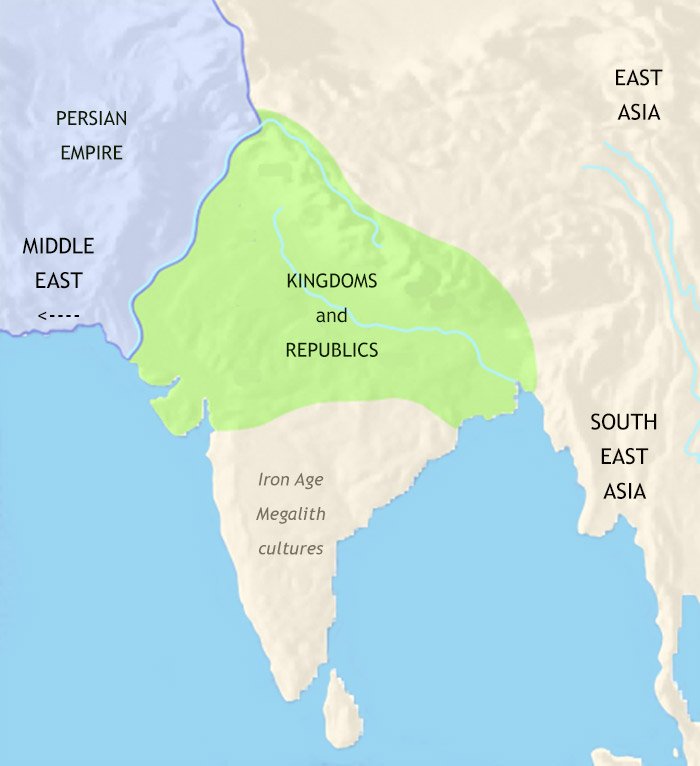
India and South Asia history 500BCE
The return of urban civilization to ancient India has been followed by a creative period in its history, with the great world religion of Buddhism being founded
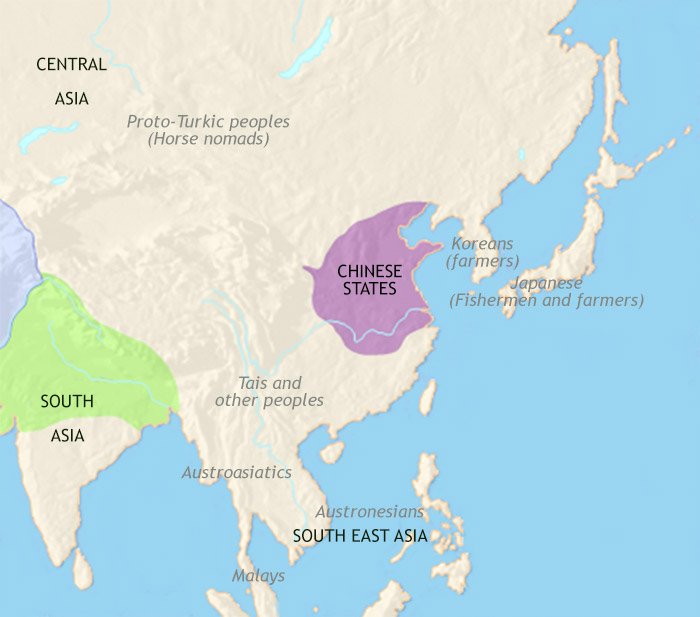
East Asia: China, Korea, Japan history 500BCE
The philosopher Confucius, whose teachings will influence millions of people down to the present day, lives at this time

South East Asia history 500BCE
The Malays and Javanese now inhabit their modern homes, and the Iron Age has come to the region

Oceania history 500BCE
The ancestors of the Polynesians have reached as far east as Fiji

South America history 500BCE
In the Amazon basin, the Arawak diaspora is in full flood

North America history 500BCE
The influence of the Olmec civilization now covers much of Central America

Subscribe for more great content – and remove ads