

The Rise of the Manchu
Some time in the late 16th century, a group of the Jurchen, a people from central Asia who were close relatives of the Mongols, migrated into what is now Manchuria. Today, this is a region of China, but at that time it lay outside the Chinese borders, just north of the Great Wall.
This group were called the Manchu.
From the 1580s onwards a leader called Nurhachi fought his way to the supreme leadership of the Manchu; he was elected khan in 1616.
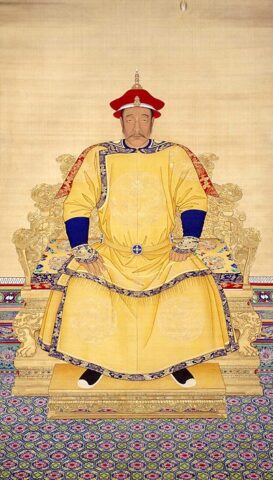
The Manchu leader, Nurhachi (Public Domain)
Nurhachi then set about recruiting Chinese gentry who lived north of the wall to help him establish a Chinese-style state with an administration modelled on that of Ming China. Nurhachi himself began to rule in the manner of a Chinese emperor rather than a tribal chieftain.
At the same time, he divided the Manchu tribesmen into groups, each identified by a coloured flag called a “banner”. These groups were units of local control, and also provided regiments for the Manchu army. Individual Manchu fought under their banners, and were known as “bannermen”.
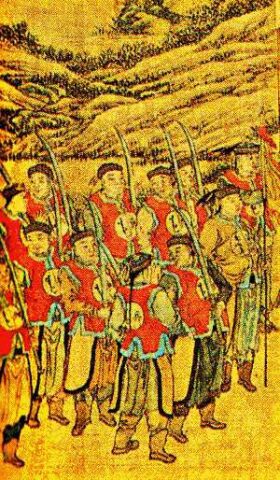
Manchu Bannermen (Public Domain)
In the Manchu army, the warrior ethic of a people of a non-Chinese tribal people mingled with the organizational and technical skills of Chinese officers, who were able to rise high in Manchu service. These introduced the European artillery technology already possessed by the Ming into the Manchu army.
The decline of the Ming Dynasty
By this time, the Ming dynasty was in steep decline. Standards of government had slipped, with a succession of weak emperors allowing violent power struggles to grow unchecked at court. The administration of the provinces was becoming more and more corrupt and oppressive.
From 1624, power fell into the hands of one of the most notorious figures in all Chinese history, the eunuch Wei Zhongxian. Wei had hundreds of court officials executed, and filled all high posts with his friends, regardless of how competent they were.
The expansion of Manchu power
Nurhaci and his son, Huang Taiji, were able to take advantage of Ming weakness and expanded their power north of the Great Wall. They brought all the Jurchen and many Mongol tribes under their control, not to mention a growing Chinese population. This was reflected in the growing number of “banners”. The original number of four Manchu banners was doubled to eight, and then trebled again to twenty-four: eight for Manchu (and Jurchen), eight for Mongols and eight for Chinese.
In 1636 Huang Taiji proclaimed the start of a new dynasty, the Qing (which means “brilliant”). The Manchu pushed the Ming forces back to the Great Wall, and repeatedly raided Chinese territory.
Huang Taiji died suddenly in 1643 and was succeeded as emperor by his five year old son. The new emperor’s uncle, Dorgon, was appointed regent, and he dominated the Manchu state until his death in 1650.
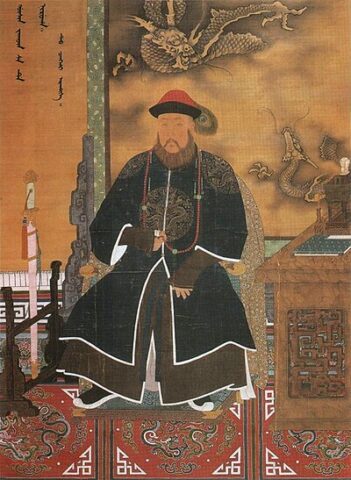
The early Qing regent, Dorgon (Public Domain)
The fall of the Ming dynasty
Meanwhile, the Ming court had continued to be paralyzed by bitter in-fighting, and standards of government had continued to deteriorate. In the face of growing corruption and oppression, banditry became widespread within China, and peasant rebellions began to break out. Eventually, in 1644, a large mass of rebels captured the capital. In despair, the last Ming emperor committed suicide.
After sacking Beijing, the rebels headed north to deal with the Ming army stationed on the frontier just 50 miles away, opposite the Manchus. This army thus found itself caught between two hostile forces. The army’s commander therefore chose to come to terms with the Manchu, and the Ming and Manchu armies together marched against the rebels, quickly routing them. The victorious force then occupied Beijing, and the Manchu regent Dorgon installed his nephew on the throne. The Qing dynasty’s rule in China had begun.
The new dynasty takes charge
On taking power in Beijing, the Qing adopted the state institutions they had inherited from the Ming wholesale. These would be in place until the final years of the dynasty, with only minor adjustments. However, in the first decades of their rule, unsure of the loyalty of senior Chinese officials, they appointed only bannermen to fill senior government posts, with a disproportionately high number of Manchus at the very top.
Taking Beijing was one thing; establishing rule over the whole of China was quite another. Keenly aware of the Manchu’s weakness, Dorgon delegated the government of southern China to three former Ming generals, the “three feudatories”.
On the young emperor’s unexpected death in 1661, his 12 year old son succeeded as the Kangxi emperor (reigned 1661–1722). For the first few years of his reign he, too, was dominated by older ministers, but on attaining personal power he proved to be one of the greatest emperors China would ever see.
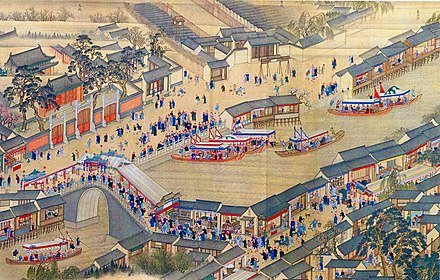
The Kangxi emperor on a tour of southern China (Public Domain)
The “three feudatories” governing southern China at first acted as loyal viceroys of the Manchu. However, they grew in confidence and assertiveness and in 1673 they rebelled against their Qing masters. It took until 1681, and much hard fighting, for the Qing forces to crush this rebellion, and in 1683, Qing forces occupied Taiwan in order to end the last flicker of resistance from forces loyal to the Ming. By then they had complete control over China.
The Kangxi Emperor
The Kangxi emperor was determined to win the Chinese over to Manchu rule. He learned Chinese, promoted Confucianism as the official ideology, and ensured that Chinese officials were able to reach the top of government in greater numbers. The emperor could only go so far in this process, however. His Manchu followers were determined to maintain their separate identity from the bulk of the Chinese population. Marriage between Manchus and Chinese was prohibited, the Manchu homeland was kept free from Chinese settlement (in theory at any rate), and Chinese men were obliged to wear queues (pigtails at back of the head) to emphasise their subordinate ethnic identity.
Also, care was taken to ensure that the most senior government posts – ministers, governors-general, governors – were shared out equally between Manchus and Chinese officials (which of course favoured the Manchu, given their tiny numbers compared with the Chinese population).
Nevertheless, the Kangxi emperor’s keen support of the traditional Chinese ideology of Confucianism won him the support of the great majority of Chinese officials. As in Ming times, these were almost all recruited by means of the ferociously competitive public examination system, which tested them in their grasp of Confucian doctrine and government matters.
Reconstruction
In the 1680s, after the pacification of the south, the Qing government set about rebuilding a country ravaged by decades of war. It granted tax remissions on a large scale, especially in the worst affected areas, and also offered tax exemptions to those willing to settled abandoned lands. They took steps to bring new lands under cultivation, with publicly organized irrigation schemes and waterway renovation; they also encouraged private land reclamation projects. Crops of American origin such as maize, peanuts and potatoes played an important part in the cultivation of marginal land, and tobacco rose in importance as a cash crop.
Internal trade flourished on a scale never seen before, though international trade continued to be strictly regulated, as it had been in Ming times. In particular, European (and later American) merchants in China were only allowed to operate in the port of Guangzhou (and for the Portuguese, Macao), where they were closely watched and supervised by Chinese officials.
The tribute system
The Manchu inherited the tributary system from the Ming in their dealings with foreign states. Korea in particular became almost a vassal state of the Qing. The Korean court sent regular embassies to Beijing, and consulted the Qing government on matters of public policy. The Qing emperor confirmed the authority of the Korean rulers, approved the Korean choice of consorts and heirs, and expected to be consulted on the Korean court’s dealings with foreign nations.
In central Asia, where the main historic threat to China’s borders still remained, a more forceful policy was called for. In the late 17th to the early 18th century, Qing armies conquered the tribes of Inner Mongolia, absorbing the region into the Qing empire. Also, in order to check Mongol advances in Tibet, the Qing occupied that country as well.
The Qing also had to contend with an entirely new element in central Asia, the expansion of Russia, which had reached the Pacific Ocean in the mid-17th century, at about the same time the Qing had ousted the Ming from power.
Diplomacy was the main – and successful – tool used here, and the Treaty of Nerchinsk (1689) fixed the border between the two huge states. Significantly, this was formulated as an agreement between equals, rather than between senior and junior parties as the Chinese were accustomed to.
The Kangxi emperor was succeeded by his son, the Yongzheng emperor, in 1722. Like his father, he was a conscientious ruler, and worked hard to maintain the efficiency of the civil service and army. He also took a keen interest in foreign policy. In 1727 the Treaty of Kyathta was signed between China and Russia, pushing the agreed border between the two powers far to the west. It also contained provisions for regulating the trade between the two countries.
The Qianlong Emperor
The reign of the Qianlong emperor (1735–96) marked the high point of the Qing dynasty – and arguably of imperial China as a whole. Like his father and grandfather before him, he was a hard-working and capable ruler.
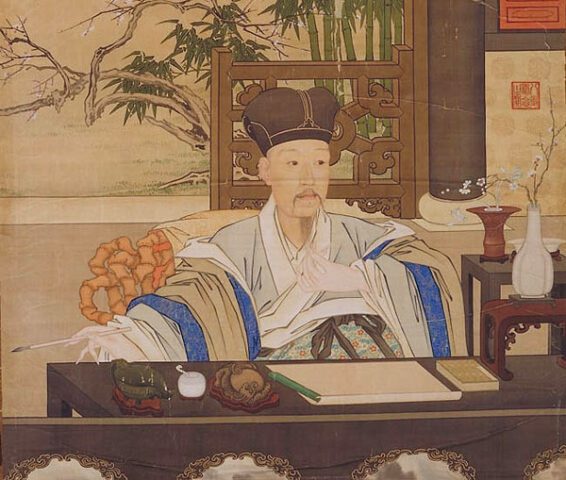
The Qianlong Emperor at work in his study (Public Domain)
The emperor inherited well-functioning government institutions from his predecessors, including a civil service at the peak of its performance and a large and comparatively efficient army. He was able to spend enormous sums on a series of military campaigns which, by the mid-18th century, had expanded the empire’s borders out as far west as Lake Balkhash, half way to Europe. These new central Asian territories were organized as the huge new province of Xinjiang.
Internally, the economy continued to expand strongly during the 18th century, as did the population (it would approximately double from 150 million at the start of the century to 300 million by the end). At least until the mid-century, expansion of food production more than kept pace. On the back of this agricultural expansion came rising standards of living for all classes, thriving commerce and increasing urbanization.
The later years of Qianlong
Sadly, the later years of the Qianlong emperor’s reign were marred by a marked decline in the standards of government. A palace eunuch named Heshen came to enjoy huge influence with the emperor. Starting at the top, corruption and inefficiency seem to have spread rapidly through government.
The Qianlong emperor abdicated in 1795, and Heshen effectively became the regent to the new emperor, who was only a child. This put him in a position of almost absolute power. However, when the old emperor died in 1799, Heshen was immediately forced to commit suicide.
China at the end of the 18th century
Measures were soon taken to reimpose discipline and rectitude on the civil service. But by this time deeper forces were undermining China’s prosperity and political stability.
At some point in the later 18th century, population growth began to outrun the ability of the economy to keep pace. The amount of food grown per person began to dwindle. For millions of peasants, never much above subsistence levels at the best of times, this was a serious matter.
Of course it was not just farming populations that were growing. The elite classes were also expanding in numbers. This naturally led to an increasing number of candidates sitting the public exams each year. However, the size of the civil service remained fixed, so that only a certain number of candidates could pass the exams. This led to a growing pool of disappointed candidates, a resentful and disaffected group who would soon provide the leadership of rebellions against the dynasty.
Opium smuggling
The mid-18th century also saw the growth of the opium trade. In the early 1770s the British East India Company began to grow the opium poppy in its Indian territories, and the crop found a ready market in China. By the mid-1790s some 4000 chests of opium were being shipped into China each year, and Chinese society was beingswept by an epidemic of debilitating drug use. An alarmed Chinese government banned the import of the crop. Unsurprisingly, the opium trade then fell into the hands of smugglers, and lawlessness (including piracy) spread along the south China coasts.
The Early 19th Century
The White Lotus rebellions
The White Lotus sect was a religious group especially widespread across northern China. It mingled Buddhist, Daoist and other teachings into a heady message promising salvation to its adherents. At times of stress it became a vehicle for dissent.
A White Lotus rebellion broke out in the mountains between the Yangtze and Yellow River plains in 1796. This was joined by bandits, smugglers and other groups on the margins of society, and continued to spread inland over a huge area.
It took Qing forces several years to suppress the rebellion, and was only achieved with heavy expenditure and significant cost to the regime’s military reputation. This episode revealed a decline in the military efficiency of the Qing army, which since the mid-18th century had not had to undertake much fighting. To make matters worse, creeping corruption in the military administration meant that many troops only exist on paper.
The White Lotus rebellion was finally ended in 1804. However, rebellion broke out again in the same area in 1813, again inspired by a White Lotus sect; and again it was only slowly put down.
The First Opium War
During the early 19th century, western merchants in China – and in particular the British, by far the numerous group of them – became increasingly frustrated by being confined to just one port, Guangzhou. Back home in Britain, commercial interests were also increasingly clamouring for the potentially huge Chinese market to be opened to them. Repeated requests to open negotiations with the Chinese court, the earliest of which had been in 1792, were ignored. The feeling grew that things needed to change, by force if necessary.
On the Chinese side, meanwhile, there was growing alarm at the growth of opium smuggling. Calls were rising that the trade should be stamped out, by force if necessary.
These tensions led to the outbreak of the First Opium War (1839-42). This ended in a comprehensive defeat for the Qing forces. The Chinese government was forced to negotiate, and the Treaty of Nanjing was the result (1842). This was the first of many “unequal treaties” between Western nations and China. These were so called because they were the result of force or the threat of force, and benefitted Western powers at the expense of China. The most significant provisions of the treaty of Nanjing were for China to hand over the island of Hong Kong (at that time barely more than a barren nest of pirates) to Britain and to open up five other ports to British trade.
The Taiping Rebellion and other Troubles
By this time the population had continued to grow (from 300 million to 400 million between 1800 and 1850), and had far outstripped the growth in agricultural production. Living standards for peasant farmers was decreasing, and rural misery was spreading. In these circumstances it would not take much for a mass rebellion to break out.
The start of the Taiping Rebellion
Hong Xiuquan (1814-64), a failed examination candidate from the region of Guangzhou, founded a religious community (with mixed Chinese and Christian beliefs) in 1851 and called for the overthrow of the Qing dynasty. Thus started the most devastating peasant rebellion China would ever experience. It would last for more than a decade, and cover a large part of China (though not all at the same time). This included the middle and lower Yangtze plain, the most prosperous regions of the country. Other rebellions soon broke out as well, affecting an even wider area.
The Second Opium War
In these desperate years the Qing court was faced with yet another challenge. With tensions unresolved from the First Opium War, Britain and other Western countries began the Second Opium War against China in 1856. This conflict saw the Qing government humiliated by a march on Beijing itself and the burning of the emperor’s Summer Palace. Once again the Chinese government was forced to negotiate “unequal treaties” with Western powers. These opened more ports (“treaty ports”) to Western trade, including along the River Yangtze, far in the interior of the country. These treaties also gave foreigners – including Christian missionaries – freedom of movement within China, and legalized the opium trade. The Russians acquired a vast portion of northeast China.
This war, however, was little more than a side-show for the Chinese. For them, the main action was the great rebellions.
The Restoration of Order
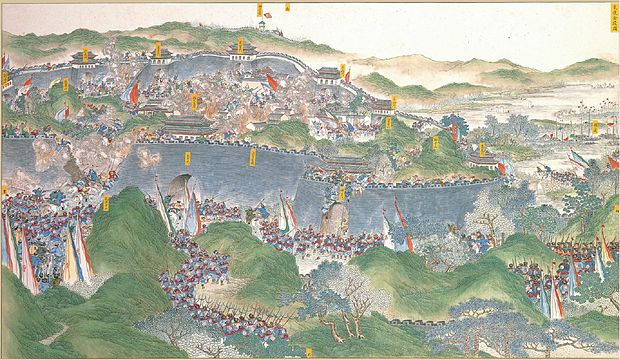
Qing troops recapture Jinling from the Taiping rebels (Public Domain)
With the imperial court in Beijing unable to deal effectively with these, Qing loyalists in the provinces had become active in raising and organizing large regional armies. Although these had the backing of the imperial court, the new forces were led and paid for independently by the local gentry in those provinces most threatened by the rebellions.
These regional armies were soon scoring successes, and were crucial in putting down the rebellions. By the time that they had been defeated, however, immense destruction had been caused, and a horrific number of deaths, from combat, starvation and massacres. The Taiping rebellion alone had been one of the bloodiest wars in human history. Estimates of the dead range from 20 to 30 million, making it the second most lethal conflict in history (after World War 2). Millions more lost their homes and possessions. Many areas had effectively been depopulated. The huge death toll of course offered some relief to the severe population pressure, particularly in the lower Yangtze region; however, the population had returned to pre-1850 levels by the last decade of the 19th century.
The Self Strengthening Movement
The Qing government set about restoring the affected regions. It sponsored large-scale immigration into depopulated areas, repaired and extended irrigation works, and reduced taxation or exempted populations from paying taxes altogether. For the gentry, the examinations, in some places suspended for 10 years, were reinstated, schools and academies were revived, and libraries restocked.
The support of the gentry had in fact proved vital in defeating the rebellions; above all it was they who had raised and led the regional armies, almost independently of central government direction. In the aftermath, therefore, the Qing regime made important concessions so that gentry control in the localities was strengthened, and their leadership of local militias and self-defence organizations formalized. These changes somewhat reduced the powers of centrally-appointed magistrates.
The fight against the various rebellions had been led by a group of remarkable men, and these now led the “self-strengthening” movement, by which western technology began to be introduced into China. Modern industries emerged with the building of shipyards, armaments factories, coal mines, railways, steamships, textile mills, and the Imperial Telegraph Administration, which had a large impact by modernising government communications. The task was also begun of creating the educational infrastructure to produce the required Chinese personnel to run these industries.
The Empress Cixi
These experiments all took place in the provinces, but recognition of the superiority of Western technology was by no means absent at the imperial court in Beijing. Here, the early 1860s saw power fall into the hands of the dowager empress, Cixi, who was to dominate the Qing regime until her death in 1908.
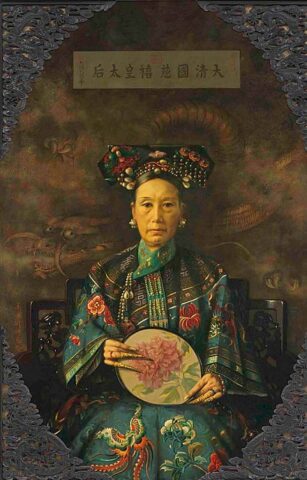
The Dowager Empress Cixi (Public Domain)
Although Cixi gave the go-ahead to many individual reforming initiatives, however, she never gave her whole-hearted support to a permanent program of industrialization that would bring about the huge changes that China so badly needed.
Anti-Christian feeling
The last decades of the 19th century saw a steady deterioration in China’s situation. The treaties which closed the Second Opium War had opened most of China up to Christian missionary activity. Wherever they went, the missionaries incurred the hostility of the local gentry. The missionaries attacked time-honoured customs such as foot-binding for women, and advocated education for girls. Missionary-sponsored schools and colleges undermined the gentry’s control of education. The Western medicine they brought (many of the missionaries were doctors) was a threat to the traditional Chinese medicine patronized by local gentry families.
Furthermore, the terrible suffering unleashed by the Taiping rebellion was associated in many Chinese minds with the influence of Christianity.
Anti-missionary incidents, which had taken place throughout the 19th century, became much more common from the 1860s onwards. When these occurred, Western powers demanded the punishment of officials who had either let the incidents happen, or even supported them. Western governments also demanded compensation, and one such incident led to a brief war between France and China (1884), in which a Chinese fleet was destroyed.
The Sino-Japanese War
However, it was not a Western nation, but an Asian one, that caused the Chinese the greatest humiliation. As Japan modernized its economy, it tried to bring Korea under its economic control. Korea had formed a key part of the traditional tributary system centered on China, and China aided the Koreans in resisting Japanese encroachments. Tensions mounted until war between China and Japan broke out in 1894.
The Chinese fully expected to win this war against their much smaller neighbor. However, they were comprehensively defeated, both on land and sea, and were forced to sue for peace. The Chinese government had to recognize the independence of Korea, to end tribute missions, and to cede Taiwan and a string of smaller islands to Japan.
Taking advantage of China’s manifest weakness, the foreign powers – Russia, Germany, France, Britain and of course Japan – demanded, and gained, “spheres of influence” within China, in which they could exercise special economic privileges.
Some senior Chinese officials saw the defeat by Japan as showing how urgently more reforms were needed, and in 1898 the Qing government embarked on a radical reform program, which came to be known as the “100 Days”. Sadly, this alarmed many conservatives, including the dowager empress Cixi. She had the leading reformers executed (though some were able to flee abroad), and though she allowed some reforms to remain in force, many of the urgent changes that China so badly needed were blocked.
The Last Years of the Qing
The Boxer Rebellion
Hatred of foreigners, particularly missionaries, increased in the last years of the 19th century, and from 1898 members of a group which used martial arts to help spread its message, and who were known as the Boxers, attacked missionaries in an ever-wider area of northern China. In May 1900 a force of Boxers marched on Beijing and laid siege to the foreign enclave there. The court, unwilling to be seen as the tool of the hated foreign powers, issued an edict blaming the foreigners for these developments.
In August, a large international force arrived in Beijing and ended the siege. The dowager empress fled the capital along with the young emperor, and the foreign troops looted the city.
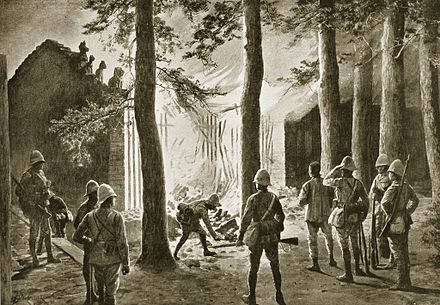
An artists’s impression of the sack of Beijing by foreign troops (Public Domain)
In September 1901 the Chinese government was forced to agree to the Boxer Protocol, by which the foreign powers demanded the punishment of Boxer leaders as well as officials who had co-operated with them.They also required the demolition of the forts defending Beijing, and the payment of a huge fine.
The Boxer episode dramatically exposed the weakness of the Qing regime. Indeed, as a dynasty of foreign extraction itself, and unable to protect the empire from foreign encroachment, millions of Chinese increasingly saw the the Qing as part of the problem rather than of the solution. In its final years it was more or less propped up by Western forces.
The end of the dynasty
In the early years of the 20th century, efforts to modernize the country continued, but these were too little, too late. Anti-Qing revolutionary movements were spreading, even in the army. In October 1911, military units in Wuchang mutinied and drove out the Qing authorities. This was the signal for army units and revolutionary groups all over China to renounce the Qing government. In Nanjing, these forces teamed up to establish a Revolutionary government. On 1st January 1912, this proclaimed the Republic of China.
The commander in chief of the army in Beijing, Yuan Shikai, marched south but after a brief clash, negotiated an agreement with the provisional government. By this, he, Yuan Shikai, would become president of the republic, while the provisional government’s leader, Sun Yat-sen, would become prime minster. Yuan Shikai then secured the abdication of the last of the Qing emperors, Puyi, a child of six.
Thus ended more than 2000 years of imperial rule in China.
For a blog post on the Qing Dynasty, please follow this link.