

The Great Wall of China is a historic system of defensive walls, originally constructed across the northern border of ancient China. It essentially follows the zone where the fertile farmland of “China proper” meets the more arid regions of inner Asia. From west to east the system skirts the southern boundaries of the Ordos desert, then the southern boundaries of the grasslands of the Mongolian steppe, and then the mountain ranges of present-day Manchuria, before reaching the Pacific Ocean.
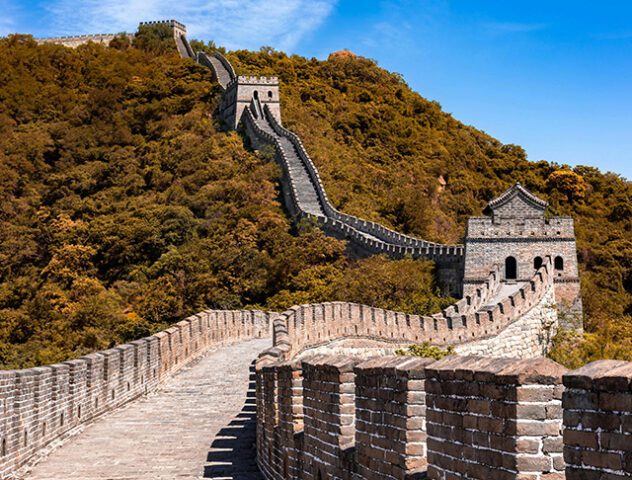
A section of the Great Wall of China
Early History
The origins of the walls date back to the chapter of Chinese history known as the “Spring and Autumn” period. At this time China was divided between many states, and the northern and western states were coming under attack by nomadic tribal peoples from central Asia. As early as the seventh century BCE, these states started building defensive walls to protect their agricultural populations from these raids. They also built other defensive systems, to protect against attack from each other, as from the six century onwards there was near-continuous state of war between them.
When all these states were conquered by the Qin dynasty, the First Emperor, Qin Shih Huang (reigned 221-210 BCE), ordered that the various walls facing inner Asia be joined together to form one single defensive system. The other walls, within China itself, were now of no defensive value, and raised to the ground.
The Han dynasty which followed the Qin maintained and extended these walls, and (until decline set in under the Later Han) kept them properly garrisoned. Even when the Han brought large areas of inner Asia under their control, leaving the Great Wall a long way behind the frontiers, the fortresses, roads and farming colonies adjacent to the walls served as a military base from which Chinese troops could be stationed and supplied, ready to project military and diplomatic power into their far flung territories.
Succeeding dynasties mostly followed the Han policies with respect to the Great Wall. However, during the Late Tang (756-907) and Five Dynasties (907-959) periods, peoples from Inner Asia occupied the northern borderlands of China, and their interest lay in maintaining contacts between the steppes and deserts of their homeland with the farming zones which they now controlled. In these circumstances the walls fell into disuse. The same situation prevailed after most of China was unified under the Song Dynasty, and more so after the Song were confined to southern China and another non-Chinese people, the Jurchen, ruled most of the north. These were followed by the Mongols, who of course had no use at all for a system of defence which divided China from the rest of their empire.
The Ming Dynasty Great Wall
The Mongols were driven out by the native Chinese Ming dynasty. The strategic value of this great defensive system came once into focus. This was even more the case after the Mongols began to threaten China. A significant moment came when a Chinese army was defeated in 1449, and the young emperor captured. He was freed again after a few years, but this was a wake-up call for the Ming government.
By this time the old walls had mostly fallen into almost complete disrepair. They had largely been built of beaten earth. This is a method of construction widely used in Ancient and Medieval China, and was quite capable of resulting in very strong structures. However, if not maintained properly it is prone to wearing away by wind and being eroded by rain. For long stretches the walls had disappeared altogether, and in many more places they were completely useless as defensive structures.
The Ming therefore set about an almost complete rebuilding of the walls. This was to be one of the most astonishing construction projects ever undertaken anywhere in pre-modern times. In many sections the construction was of brick and stone facing, with rubble interiors. In other sections rammed earth was still used.
It is important to note that what we call the Great Wall of China was never just one long wall, as Hadrian’s Wall across northern Britain was. In some places it was two sets of parallel walls, in other places it used natural features such as cliffs, mountain slopes and river banks to provide most of the defensive element. Furthermore, throughout its length the wall was associated with a whole series of other structures. At certain strategic locations large fortresses were built, with barracks for large garrisons. Wherever suitable, land was brought under cultivation to limit the need to transport food and other supplies to the frontier. Towns came into being where local produce could be stored and distributed, and where workshops could produce and maintain weapons. The whole defensive system was also associated with roads along which goods could be transported, troops marched and news carried.
The wall itself was punctuated with beacons and watchtowers, often at half mile intervals. When needed (and presumably when viability was adequate) fires could be lit to convey alarms along the line, and even back to the capital.
Did it work?
This all provokes the question, did the Great Wall actually work?
Certainly in one respect it was a huge asset to China (though only when it was kept in state of good repair and properly manned). This was that it put a stop to frequent smaller – but still destructive – raids by steppe nomads against the farming population of northern and western China. For long period of time they could get on with their lives in peace and security.
As for large-scale invasions of China, there are a number of successful examples of these after the Great Wall had been constructed. However, there is only one case of a major movement of invaders through the wall while it was in good repair and properly manned. This was, ironically, the occasion when the Ming dynasty, the main architects of the modern Great Wall, fell from power. However, this happened because the local Chinese general in the service of the Ming invited Manchu forces across in order to aid his own forces retake Beijing from rebels, who had occupied the capital.
So in this respect, the Great Wall of China also served its purpose.
Furthermore, the Great Wall was probably never intended solely for defence. It also served as a way of supervising traders and others going in and out of China, and of exacting duties on goods being imported and exported. In this respect, it will have boosted the treasury of the imperial government, and thus encouraged emperors and their advisors to promote international trade along the Silk Road.
After the Ming dynasty, the Manchu emperors of the Qing dynasty followed a “forward” policy, conquering a huge chunk of central Asia. Once again, the Great Wall ceased to be useful for defence, and once again it fell into disrepair. It was only in the twentieth century that the sections of it nearest to Beijing were renovated, and now attract more than ten million tourists a year to be awed by the sheer engineering achievement it represents.