

Overview and Timeline of Ancient Greek Civilization
The civilization of Ancient Greece emerged into the light of history in the 8th century BC. Normally it is regarded as coming to an end when Greece fell to the Romans, in 146 BC. However, major Greek (or “Hellenistic”, as modern scholars call them) kingdoms lasted longer than this. As a culture (as opposed to a political force), Greek civilization lasted longer still, continuing right to the end of the ancient world.
Timeline of Ancient Greece:
776 BC: Traditional date for the first Olympic Games
c. 750: Greek cities start planting colonies on other Mediterranean coasts, adapt the Phoenician alphabet for their own use, and later adopt metal coinage from Lydia, in Asia Minor
594: Solon gives Athens a new constitution; this is the start of the rise of democracy in Greece
490-479: The Persian Wars – Athens and Sparta lead the Greeks in defending their land against invasion from the huge Persian Empire
447: Work begins on the Parthenon in Athens, then at the height of its glory
431-404: The Second Peloponnesian War – Athens is defeated by Sparta, which now becomes the leading power in Greece
399: The Athenian philosopher Socrates is condemned to death for questioning conventional ideas
338: King Philip II of Macedon defeats the Greek city-states and imposes his dominion on them.
Philip of Macedon’s defeat of the Greek city-states is traditionally seen as drawing down the curtain on “Classical Greece” and ushering in the “Hellenistic Age“. This includes the conquests of Alexander the Great, and ends with the conquests of the different Hellenistic states by Rome (146-31 BC).
The history of Ancient Greece falls into four major divisions. The Archaic period , when the civilization’s main features were evolving, lasted from the 8th to the 6th centuries BC. Classical Greece flourished during the 5th to 4th centuries BC. This was marked by the period of the Persian Wars (c. 510-479 BC), the Golden Age of Athens (c. 479-404 BC), and the later Classical era (404-338 BC).
Greek civilization had a powerful influence on the Roman civilization. Indeed, some modern scholars see the Roman era as a continuation of the same civilization, which they label “Graeco-Roman”. In any case, the Roman conquest carried many features of Greek civilization to far-flung parts of the Mediterranean world and Western Europe. Through the mediation of the Romans, therefore, Greek civilization came to be the founding culture of Western civilization.
The Geography of Ancient Greece
The geographical coverage of Ancient Greek civilization changed markedly during its history. Its origins were in the land of Greece and the islands of the Aegean Sea, plus the west coast of Asia Minor (modern Turkey). This is a landscape of mountains and sea. Land useful for farming is found in valley bottoms, hedged in by steep slopes, or on small islands, confined by water. As a result, ancient Greece consisted of many small territories, each with its own dialect, cultural peculiarities, and identity. Cities tended to be located in valleys between mountains, or on narrow coastal plains, and only dominated a limited area around them. These “city-states” were fiercely independent of each other.
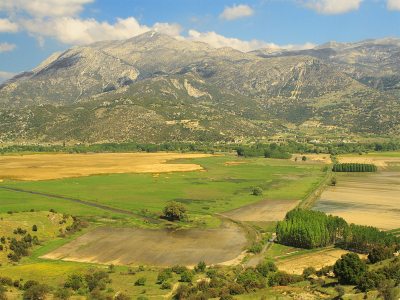
Steep hills cover much of Greece
From about 750 BC the Greeks began sending out colonies in all directions, settling the coasts and islands of the Mediterranean Sea and the Black Sea. By around 600 BC Greek city-states could be found, “like frogs round a pond”, as one Greek writer put it, from the coasts of Spain in the west to Cyprus in the east, and as far north as present day Ukraine and Russia and as far south as the Egypt and Libya. Sicily and Southern Italy above all became a major locus for Greek colonization, and this region was known to the Romans as “Magna Graeca”.
Later, the conquests of Alexander the Great took Greek civilization right across the Middle East. There it mingled with the more ancient cultures of that region to form a hybrid civilization which scholars label “Hellenistic” civilization. This is described in a separate article; here we shall focus on the original Greek civilization.
Society in Ancient Greece
The ancient Greeks certainly thought of themselves as ‘one people’ – they had the same religion, language and culture. Every four years all Greek city-states sent their young men and women to compete in the Olympic Games. Politically, however, Ancient Greece was divided amongst several hundred independent city states (poleis). These city-states fiercely defended their independence from one another. Political unity was not an option, unless imposed from outside (which first occurred when Philip II, king of Macedonia, conquered the city-states of Greece in the mid-4th century BC.)
The City-State
A typical Greek city was built around a fortified hill, called an “acropolis”. Here was located the city’s chief temple, the city’s treasury, and some other public buildings.
At the center of the city was the “Agora” – the central space where public meetings were held, and where traders set up their stalls. The agora was often flanked by colonnades.
Most industrial production took place in small workshops. Family members plus some slaves would make up the workforce in most of these. However, one workshop in Athens for manufacturing shields was said to have 120 workers, mostly slaves. Different trades were concentrated in different parts of the city, but mostly near the agora, the main trading center in the city. Potters, blacksmiths, bronze workers, carpenters, leather workers, cobblers, and other craft workshops would all have their own streets or (in large cities) districts.
As a city outgrew its local water supply, water was brought in from neighboring hills by means of channels cut in the rocks, and clay pipes. These fed fountains, from which the poorer people could collect water; and also private wells situated in the larger houses.
The city was surrounded by high, wide walls. In later times these were made of stone, brick and rubble. Towers were built at regular interval, and fortified gateways pierced the walls to allow roads to pass through.
Outside these wall was another public space, the gymnasium. This is where athletes trained; covered porticoes allowed training to continue in bad weather, and also provided shaded areas for activities such as music, discussion and social meetings. Many gymnasia had public baths attached.
Also outside the walls would be the theatre, built into a hillside and semicircular in shape. The audience would sit on the tiered seats looking down on to a space called the “orchestra”, where the performances took place. This space would be backed by columns and behind them, small buildings where actors changed clothing and masks, and for the props.
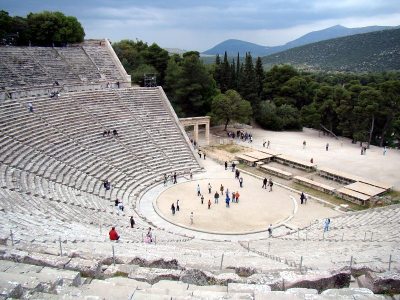
Theaters such as this were situated outside many Greek cities
Surrounding the city was the farmland of the city-state. Many of the citizens lived within the city walls and walked out to their fields each day to work. Those whose land was further away, however, lived in the countryside, in the hamlets and villages which doted the landscape, and walked into the city for special occasions. They were as much citizens of the city-state as those who actually lived in the city itself.
In many cases this farmland only stretched for a few miles before sloping upwards to the hills and mountains which divided one city-state from the next. Here, with the land less suitable for growing crops, grain fields and olive groves gave way to pasturage for sheep and goats.
Many Greek city-states were situated on the coast, or on a small island. The city itself would often be located some distance inland, centered on a hill where the acropolis was built for defense. On the seashore would be a harbor, consisting of wooden quays for loading and unloading ships, and beaches were the ships could be drawn up onto dry land for repair. In many cases there would also be ship-sheds, where the city’s war galleys were housed when not in use.
(Click here for how these city states came into being.)
Agriculture
Like all pre-modern societies, the Greeks were primarily an agricultural people. They practiced the agriculture of the ancient Mediterranean region. involving the cultivation of grains, vines and olives, and the keeping of sheep, goat and cattle.
Farms were very small – mere plots of land of a few acres. Aristocrats and other landowners would own larger farms, worked by slaves; but an estate of 100 acres was considered large.
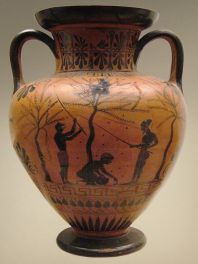
This vase depicts harvesting olives, a major crop in ancient Greece
The main challenge facing Greek farmers was that there was too little good farming land in Greece and the Aegean. This forced them to take to sea-borne trade on a scale unmatched by most other ancient peoples. However, land shortages continued to be a problem throughout the ancient times. They were a source of the social tensions between rich and poor which led, in Athens, to the rise of democracy, and in several other cities, to violent clashes between the different classes.
Trade
Very many Greek city-states were located by the sea. Also, many of them, confined as they were by steep hills and mountains, or by the sea itself (if they were on islands), suffered from a shortage of agricultural land. From an early stage in their history, therefore, many Greeks looked to the sea for their livelihood. For a period of about 150 years after 750 BC, many city-states sent out groups of their citizens to found colonies on distant shores of the Mediterranean Sea and the Black Sea. These established strong trading ties with their mother city. Greek traders soon dominated maritime trade of the Mediterranean, edging out the Phoenicians who had preceded them. The adoption of metal coinage must have facilitated this process.
Some Greek cities became large and wealthy trading centers. Athens, the largest Greek city-state of all, was only able to feed her large population through trade. The poor soil of Attica (the area of Greece where Athens was located) was ideal for growing olives on, and so from an early date the Athenians concentrated on growing olives for export. They imported almost all their grain from other states. The Athenians built up a large merchant fleet, and their city became the leading commercial center of Greece. At the height of its glory, almost a third of its population may have been made up of “alien” businessmen and their households, mostly Greeks from other cities. The wealth that this commerce brought Athens enabled it to become the leading city of Greece, both in politics and culture.
Athens also became the major banker to the Greek world. In the fifth century BC the Athenian coinage became the international currency of the Mediterranean. Bankers operated from long tables set up in the agora, making loans at very high rates of interest.
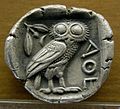
Athenian coins were used throughout the Mediterranean
Society
The social framework varied significantly from city-state to city-state. Most cities, however, had a large class of free, native-born peasant farmers. These owned small farms to subsist on. The adult males formed the citizen body of the state. They were entitled to vote in elections, participate in trials in the law courts, and hold public office; They also had a duty to fight in the city’s army. They had a real say in how their city was run and what decisions were made.
Within this group of citizens was a smaller number of wealthier families, who owned more land than the rest. They were the aristocrats. As they could afford to keep horses, they were distinguished from the bulk of the citizens by fighting in the army of horse-back. Their older men were often the leading office-holders in the city, the magistrates and military commanders; they could often trace their families back through generations of office-holders, who had helped shape the city’s history. They had a disproportionate influence on affairs of state. Indeed, in many city-states they formed an aristocratic council who played a leading role in the direction of the state. In those city-states which were democracies, however, it was the bulk of the citizens who held the power, through their assembly.
At the bottom of society was a large class of slaves – modern scholars estimate that in some city-states such as Athens they may have made up almost half the population.
These were people who had been captured in war, or been condemned to slavery as a result of debts which they could not pay; or for crimes. Since the children of slaves were also slaves, many had been born into slavery. In law they were the property of their owners. They worked as household servants or farm laborers for the wealthy, or miners and industrial workers for businessmen. Trained slaves could act as skilled craftsmen, or perhaps secretaries.
As the Greek cities grew in size and wealth, their societies became more complex. New classes appeared, of prosperous craftsmen, sailors and traders, to stand alongside the older classes of aristocrats, peasants and slaves. These new groups became the natural opponents of the aristocrats, and their influence in politics helped undermine aristocratic power. It is no coincidence that those cities with the largest commercial sectors moved furthest along the road to democracy.
Most city-states also had numbers of “aliens” living within their walls. These were free men and women who had homes in the city, but had been born elsewhere (or their parents and grandparents had), usually in another Greek city-state. They were often merchants or craftsmen. They were not enrolled amongst the citizens and did not have their privileges; they were deemed to have the citizenship of the city they or their families had originally come from. In most cities, citizenship was jealously guarded by a hereditary group of native families.
The Family
As in many pre-modern societies, unwanted children were exposed in the countryside to die. Sons were preferred over daughters, so it was baby girls who tended to suffer this fate. Exposure was not illegal, though once the baby was more than 10 days old it was fully protected by law. Exposed babies were often rescued and brought up as slaves.
Babies in wealthy families were usually breast-fed by a household slave. Older children had toys to play with, as in all societies: rattles and balls were popular, as were dolls.
Boys from wealthier families went to school (see the section on education, below), and some girls were also educated. Poorer boys would be trained in a craft, on the job. This often involved picking up the rudiments of reading, writing and arithmetic.
Women lived very sheltered lives, first under the authority of their father or another male relative, and then under that of their husband. Marriages were arranged by the parents.
The man was very much the dominant partner in a marriage (at least in law). The role of the woman was to cook, weave, raise her children. In poorer families, a woman might also help her husband in his work, especially if he worked on a farm (which the majority of men did); or she herself might keep a market stall or do some other kind of work.
Divorce was easy for men – they could divorce their wives without justification – and almost impossible for women.
Houses
The majority of the poor lived in what we would regard as squalid rural hovels, or crowded urban slums crowded together in narrow, filthy lanes. In a large city like Athens, some of the poor lived in multi-story blocks of apartments.
Larger houses were constructed around a courtyard, with rooms leading off. Some of these were quite modest, for well-to-do craftsmen or farmers; some were large and luxurious, with accommodation for a large household including many slaves. These houses were of two stories, and were equipped with bathrooms and toilets. The walls of the reception rooms and family quarters were painted with large, colorful scenes.
Clothing
Men wore tunics, over which a large piece of cloth could be draped. Women wore long tunics falling to their ankles, and they too could drape large pieces of cloth over themselves. These tunics and cloaks were mostly made of wool. Children’s clothing consisted of short tunics. Leather sandals were worn on the feet.
Young men tended to be clean shaven, with hair cropped short. Older men often wore beards. Women grew their hair long, then tied it into a bun or pony tail with ribbons.
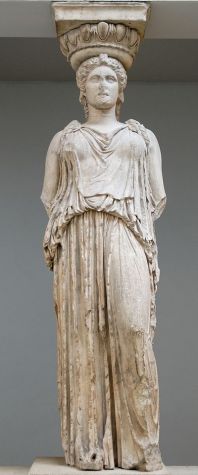
Statue of the goddess Athena, dressed in typical Greek women’s clothingBritish Museum
Government and Politics in Ancient Greece
The English word “politics” comes from the Greek word for city-state, “polis”. For the Greeks, the city-state was essentially a community of citizens making decisions together about matters of communal concern. This is why the Greeks never referred to the name of a city – “Athens”, for example – but always to its citizens – “the Athenians”.
Citizens were the free members of the community who had been born to native families (those who had lived in the city-state for generations). From the earliest days of the city-states the adult male citizens would regularly meet together in public assembly to decide matters of importance for the state. This was made possible by the fact that most city-states would have no more than a few thousand such citizens.
In contrast to political developments in Mesopotamian city-states, more than two thousand years before, kings early on lost most of their power in Greek city-state, and in many cases vanished altogether. From that time onwards these city-states were republics rather than kingdoms.
In all the states, a small group of aristocrats initially had a controlling position. They formed a small council of men who frequently met to discuss public matters in depth – something that a large assembly of several thousand citizens could not do.
Democracy
Many citizens’ assembly gained more and more power, however, and in the fifth century BC many states were full-blown democracies(the word “democracy” is based on the Greek word for common people, “demos”.)
Athens was by far the largest and most famous of these democracies, and we know a great deal about how Athenian democracy worked. The citizens not only met in a full assembly, but chose (by lot) some of their members to form a much smaller council, which discussed public matters more fully before laying them before the full assembly. Public officials were also chosen by lot (except military commanders, who were elected). All citizens were liable to be selected for public office or membership of the governing council, and would serve for a year. In this way, office-holding was constantly rotating, and the majority of citizens gained some direct experience of government.
(Click here to find out how Greek democracy arose.)
Public finances and administration
Taxation seems not to have been highly developed by the Greeks. Taxes were levied in times of emergency; otherwise, government was supported financially by duties on goods being bought and sold, or on property.
In fact, Greek government was not expensive by later standards. There was no bureaucracy to speak of. Some cities kept public slaves for various tasks (rudimentary police force, or a small corps of public scribes, for example), but their numbers were very small. Public officials and soldiers were largely unpaid, serving their cities voluntarily (Athens was an exception, paying citizens for undertaking public duties; but it was an exceptionally wealthy city). Moreover, the wealthy were expected not only to serve as magistrates or generals, but to contribute funds from their own pockets for the upkeep of warships, theaters and other public assets.
Law
We know surprisingly little about Greek law. No law codes have survived, except in small fragments; enough has survived, however, tell us that the Greek city-states wrote down their laws on stone tablets and set them up in public places (presumably the open space known as the Agora). Greek histories tell us much the same ting when dealing with such famous law givers as the Athenian Solon.
Each polis had its own law code. We know most about the legal system of Athens, as in most things. Here, there were many courts, each trying different kinds of case. Very serious crimes against the state came before the entire assembly of citizens. Capital punishment was inflicted for blasphemy, treason and murder – the method differing for each crime but including beheading, poisoning and stoning. For other serious crimes, including manslaughter, exile was a common punishment. For lesser crimes, fines or confiscation of property were used.
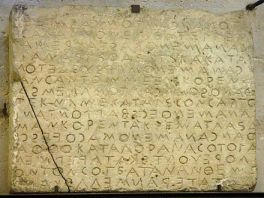
A law code inscribed on stone, from Gortyn, Crete
The Louvre, Paris
In all courts, cases were tried by large juries of citizens, selected by lot, and presided over by a magistrate. Any citizen could bring charges against another. – but to limit the bringing of false accusations any accuser who failed to convince a fifth of the jurors was heavily fined. The accuser put his case, and the accused then defended himself. The jurors cast their vote as they left court by each dropping a pebble into a jar for guilty or for innocent.
A board of eleven magistrates was responsible, with the help of a body of slaves, for maintaining law and order, arresting wrong-doers and supervising prisons (which were mainly used for condemned prisoners awaiting execution).
Although we know little about Greek law, there can be no doubt that Greek law would have a profound influence on Roman law, not least in the fact that the earliest laws of the Romans were inscribed on stone tablets and set up in a public place.
International politics
As time went by, most city-states of Greece did in fact give up a measure of their much-prized independence to form alliances with one another, against joint enemies. They did this often voluntarily, but sometimes under coercion.
The most famous of these alliances were the Delian League and the Peloponnesian League, led by Athens and Sparta respectively.
The Delian League originated as a defensive alliance against the Persian threat, being founded in the early fifth century. However, as time went by, Athens became more and more dominant, treating the other league cities more as subjects than as equals. This behavior eventually helped lead to the downfall of the League (click here for more in this period of Athenian history).
The Peloponnesian league was founded much earlier than the Delian, in the 7th century BC, and endured much longer. Its chief city, Sparta, had achieved its position of leadership largely through military means; however, the League served the interests of the other cities by offering them effective protection from non-League enemies. Also, Sparta made sure that League cities were under aristocratic regimes which tended to be in favor of Spartan values (click here for more on Sparta and the Peloponnesian League and its later leading role in Greece.
Warfare
The city-states relied on their own citizens to fight in their armies. Each citizen had to have his own armor and weapons, and spend a certain amount of time undergoing military training. The fact that the Greek world was fragmented into hundreds of small city-states, with only a few thousand citizens each, meant that wars, though frequent, were limited the scale. The duration of campaigns was determined by the need for most of the citizens to return to their farms for harvest time. Campaigns would therefore often be restricted to summer.
Battles were fought between large formations of foot soldiers, fighting at close quarters: the majority of the casualties in a set-piece battle would obviously occur at the front of the two formations; if one of the sides turned and ran (a not infrequent occurrence) the all were in danger. Cavalry played a comparatively minor role in Greek warfare.
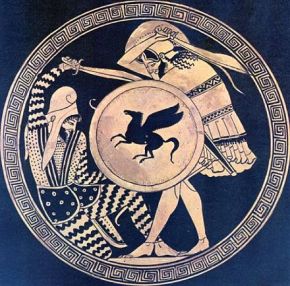
A hoplite fighting a Persian soldier
A hoplite, or heavy-armed infantry soldier, was armed with a spear, large shield, and helmet. Swords might also be carried, but as a secondary weapon. Better-off hoplites would have in addition a bronze breastplate and greaves. These would tend to fight in the front line, the place of most honor.
The scale of Greek warfare increased somewhat in the 6th century BC, when groups of city-sates formed alliances. The most famous of these was the Peloponnesian League, under the leadership of Sparta. During the Persian Wars, the Delian League emerged, under the leadership of Athens. These and other leagues (the Achaean, the Aetolian) increased the scale of Greek warfare further in the 5th and 4th centuries. Large armies were fielded, forces were deployed further from their homes, and campaigns grew longer. Naval warfare became more important, with several city-sates maintaining large fleets of galleys (the rowers of these galleys were usually the poorest of the citizens, who could not afford to pay for their own armor). Blockades and sieges became common.
In Hellenistic times the scale of Greek-style warfare would become much larger still.
Ancient Greek Religion
The Greeks worshipped a pantheon of gods and goddesses, headed by the chief of the gods, Zeus. Other gods included Hera, Zeus’s wife; Athena, goddess of wisdom and learning; Apollo, god of music and culture; Aphrodite, goddess of love; Dionysus, god of wine; Hades, god of the underworld; and Diana, goddess of the hunt.
Greek religion placed little emphasis on ethical conduct – stories about the gods portrayed often them as lying, cheating, being unfaithful, getting drunk and so on. As in many traditional religions, a Greek god or goddess was seen more as a potential source of help, rather than as a focus of devotion.
Each city-state had its own festivals, but certain festivals were common to all the Greeks. The most famous of these were the Olympic games, held in honor of Zeus every four years (starting traditionally in 776 BC). There were much fewer events than in a modern Olympics, and there were competitions in music and poetry as well as in athletics. The winner of an Olympic event was awarded an olive wreath and won great honor in his home city.
The Greeks often consulted oracles – priests or priestesses at certain shrines who, in a trance, uttered messages from the gods. People would go to oracles for advice and guidance on specific matters. The most famous of these was the oracle at the shrine of Apollo at Delphi. Advice was sought by private individuals as well as by politicians and military commanders.
The Greek religion was not something to engage a person’s spirituality, and various cults grew up to fell that void. The Eleusian Mysteries and the cult of Orpheus injected an emotional elements into worship. One joined these through initiation, and their beliefs were secret. Hence we know little about them. However, they stressed the importance of the afterlife – initiates were promised immortality – and the need for ethical standards of behavior were emphasized.
Numerous myths have come down to us about the Greeks gods, goddesses and semi-divine heroes. They also have much to say about the origins and nature of the world. Many of these myths contradict one another, something that the Greeks found no problem with.
Ancient Greek Education
Most Greek cities did not have publicly-funded schools – Sparta was the exception. Education was therefore a private affair.
Wealthy families would put a boy under the care of a slave who would accompany him everywhere. The boy (and the accompanying slave) would attend a small school run by a private teacher, who would have a few pupils in his charge. Here, the boy would learn to read and write, and do arithmetic. Later, they learned to sing and play music (which for the Greeks included poetry).
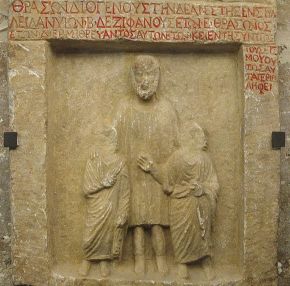
A slave accompanies his two charges to school
After the age of 12 boys focussed on physical education. They trained in such sports as the throwing the discus and javelin, running and wrestling.
Some wealthy families would also have their girls educated. They would be taught to read, write, and play music; and they were also given also some physical education.
After school, older boys underwent military training. The family bought armor and weapons for them, and the young men learnt how to fight effectively in military camps. From this age they were expected to serve in the state’s army, if needed.
For boys from wealthy families, training in public speaking would round off their education. In Athens, some of the first higher education institutions recorded in history were founded: Plato’s Academy and Aristotle’s Lycaeum. Here, courses involving logic, literature and philosophy were taught.
Meanwhile, girls from wealthy families were trained in managing the household. This would have involved account-keeping, as well as more domestic tasks such as weaving. In fact, how educated a young woman actually became would have depended entirely on her family, and of course her own motivation.
The Cultural Life of the Ancient Greeks
Literature
Even while the Greeks were emerging from their Dark Ages after the fall of Mycenae (c. 1200-750 BC), when they produced their greatest poet, Homer. Most modern scholars think that Homer’s two epic poems, the Iliad and the Odyssey, were composed around 750 BC. It was almost certainly first composed in oral form before being written perhaps a hundred years later. These poems have been studied by western scholars ever since.
Later poets included Hesiod (7th century BC), whose “Works and Days” portrays the tough life of an ordinary farmer; Sappho (6th century BC), whose love poetry uses beauty of language to explore intense personal feelings; and Pindar (late 6th century – early 5th century BC), who expressed emotion in lyrical poems praising famous athletes or gods, and mourning the dead.
The Greeks were the first to pioneer the art form of drama. This had its origins in the dances and songs of sacred rites, and was always associated with religious festivals. A chorus chanting words or singing songs replaced the dancers, and originally only one solo actor stood out from the rest. Actors wore different masks to depict various standard moods or characters.

Actors wore masks such as this
3304 – Athens – of Attalus Museum – Theatre mask – Photo by Giovanni Dall’Orto, Nov 9 2009 by Giovanni Dall’Orto
Greek drama included both tragedy and comedy. It reached maturity in 5th century Athens. Aeschylus (525-456 BC) reduced the importance of the chorus, and increased the role of individual actors and dialogue. Sophocles (496-406 BC) took these innovations further, while Euripides (484-406 BC) used dialogue to portray deep human emotions.
The Greeks also pioneered the writing of history as not merely the chronicling of events, but in striving for accuracy, objectivity and meaning in their accounts. Herodotus (c. 485-425 BC) is known the “father of history” (in the West), and was the first to develop a coherent historical narrative (in his case, of the Persian Wars); but it was his successor, Thucydides (c.460-396 BC), who was the one to first write what we today would call proper history.
Art and Architecture
Greek architecture is known for its grace and simplicity. The finest buildings the Greeks erected were their temples; and the most famous of these is the Parthenon, in Athens.
The center of each temple was space known as the “cella”. Here was located the statue if the god. In front of the cella was the porch, and both porch and cella were surrounded by a colonnade of columns. Each column was topped by a “capitals”, a carved block of stone. On top of these rested the “entablature”, a band of carved stone on which, in turn, rested the roof. These elements went together to form a simple yet gracious building.
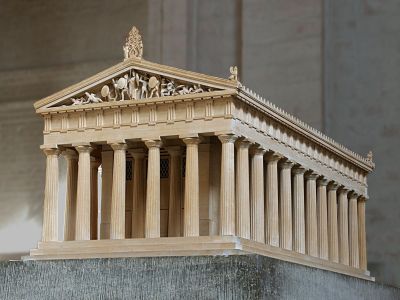
A typical Greek temple
A model of the temple of Aphaia, Aegina, in the Glyptothek, Munich
Sculpture and Painting
Greek sculpture – usually in stone and bronze; sometimes in gold and ivory – was solid and formal, much like that of the ancient Middle East. In the Classical period, sculptures strove for realism, and their work became more graceful and elegant. They applied mathematical ratios to achieve aesthetic beauty. As time went by, and their skills improved still more, they sought to represent movement and emotion. In their best works they achieved a fluidity in stone which has seldom been matched.
In ancient times, statues would have been painted with vibrant, lifelike colors. Virtually no trace of this survives. The only paintings that have come down to us are on vases, where the images are of necessity simple and economic. We know of other painting as well from literary sources, for example on walls of palaces; and some painters achieved wide fame. However, none of their work has come down to us.
Philosophy
The earliest school of Greek philosophers were those of the Ionian tradition (7th-5th centuries BC). Ionia was in what is today western Turkey, and it is tempting to see the influence of the ancient Middle East on their work. Much of this involved quasi-religious speculations about the origins and structure of the universe: but this led them on to quasi-scientific propositions, such as that all matter comes from water (reminiscent of Mesopotamian beliefs).
The Pythagoreans were another group of early Greek thinkers (6th-5th century BC). They formed a curious combination of philosophical school and religious brotherhood. They believed that all things could be explained by numbers. As a result, they did much mathematical speculation (see below, section on Science). However, they believed in such religious ideas as the transmigration of the soul. They lived simple, ascetic lives.
By the 5th century, Greek thinkers such as Parmenedes (c.504-456 BC) were advocating the idea that reason is the best way to reaching truth.
The Sophists – “teachers of wisdom” – were traveling teachers prominent in the 5th century, after the Persian Wars. They preferred to study man and worldly problems rather than speculate about universal truths. In fact, some claimed that truths were only meaningful when placed in a particular context, and seen from a particular point of view. They rejected the notion of the supernatural and universal standards of morality and justice. Some went on the state that nothing really exists, the material world is just an illusion. Some taught that all the meaning there is in the universe resides in the words we use. Language is therefore a tool to give things meaning. In due course sophists came to be associated with specious reasoning, using words to mean whatever one wants them to mean.
Greek philosophy reached its high point in the careers of three thinkers who lived and worked in Athens, Socrates, Plato and Aristotle.
Socrates (469-399 BC) challenged the thinking of his contemporaries by posing penetrating questions. In this way he aimed to strip away the prejudices we all bring to our thinking. He developed the “Socratic method”, based on questions and discussion, rather than on lectures and received teaching. He believed that reason and clear thinking could lead men to truth and happiness. In 399 BC, he was put on trial in Athens for “corrupting the minds of the youth” and not revering the gods. He was executed by poisoning.
Plato (427-347 BC) was a disciple of Socrates; it is through him we know of Socrates’ teaching. Plato believed that the material world is not real, but an imperfect image of the real, or ideal. He founded the “Academy”, the first known institute of higher education in the West.
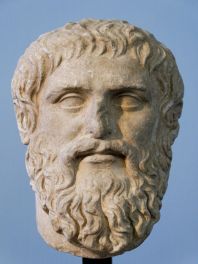
A bust of the philosopher Plato
Aristotle (384-322 BC) was a student of Plato’s. He spent some time as tutor to the future king of Macedon, who would become known to history as Alexander the Great. After this, he founded the Lyceum in Athens. Aristotle left behind a vast body of work. To help clear thinking, he developed a system of formal rules of logic. These became extremely influential in future Western thought. He believed ideas were indistinguishable from matter, in that they could exists only through material objects. He believed that God was the “first cause” of all things, and that the good life can be achieved through moderation.
Greek thought would continue to evolve in Hellenistic times, with the Stoics and Epicurians becoming particularly prominent.
Mathematics and Science
For the Greeks, science was indistinguishable from philosophy (in fact, science was called “natural philosophy” in the West right up to the 18th century).
Thales of Miletus is usually regarded as the first prominent Greek mathematician, and he is credited with developing the methodologies of observation, experimentation and deduction, which are still used today. Thales’ younger contemporaries, Pythagoras and his school, developed geometry as a branch of knowledge. They uncovered Pythagoras’ theorem, that the sum of any three angles of a triangle is equal to two right angles.
One of the main concerns for Greek philosophers was the nature of the universe, and their thinking about this had theological dimensions – Heraclitus (533-475 BC), for example, believed that the universe pervaded by Logos, or divine will, and Xenophanes (540-485 BC) taught that was a supreme being, and attacked the idea of a pantheon of gods – and some was more along what we today would recognize as scientific lines.
Empedocles (495-430 BC) proposed that all matter was indestructible and eternal. He was the first to come up with the idea that matter exists in only four basic forms – earth, air, fire and water. Different balances lead to different kinds of materials. Democritus (c.460-362) developed this idea and anticipated modern physics by proposing that all matter consists of minute and indivisible units called atoms.
Anaximander (611-547 BC) asserted the theory of organic evolution, with the earliest animals being fish, which later adapted to different environments to become land animals and human beings.
In medicine, the Greeks dissected animals to refine their ideas on anatomy. They located the optic nerve and recognized the brain as the locus of thought. They discovered that blood flows to and from the heart. Hippocrates (c.460-377 BC) argued that diseases had natural rather than supernatural causes, and that they therefore could be treated by natural means. He advocated rest, proper diet, and exercise for a healthy life; he knew the uses of many drugs, and he helped improve surgical practices. He is considered one of the key figures in the history of Western medicine.
In astronomy, the first three-dimensional models to explain the apparent motion of the planets were developed in the 4th century BC.
Aristotle advanced the scientific method by his insistence on observation of the material world being an important root to knowledge. Together with his rules of logic (see the section above, Philosophy), this laid some important foundations for the scientific method in the West. He put this method into action himself by classified many plants and animals, so making a great contribution to botany and zoology. He developed Empedocles’ ideas on matter by adding a fifth element, ether, to the other four.
Greek mathematics and science continued to make advances in Hellenistic times.
The Legacy of Ancient Greece
The civilization of ancient Greece has been immensely influential on subsequent world history. The language, politics, educational systems, philosophy, science, and the arts of the ancient Greeks were crucial in laying the foundations of Western civilization. Through the Roman Empire, much Greek culture came to Western Europe. The Byzantine Empire inherited Classical Greek culture from the Hellenistic world, without Latin intermediation, and the preservation of classical Greek learning in medieval Byzantine tradition further exerted strong influence on the Slavs and later on the Islamic civilization of the Golden Age. Through these channels it came again to Western European in renewed force, and was hugely instrumental in stimulating the Italian Renaissance.
The art and architecture of ancient Greece have had an enormous impact on later cultures, from ancient times to the present day. This is particularly the case with sculpture and architecture. Roman art was largely a continuation of Greek – in fact, in many cases it was actually executed by Greek artists. In the East, Alexander the Great‘s conquests led to the rise of the hybrid Hellenistic civilization in which Greek and Asian styles mingled. The distinctive Persian art of the medieval period incorporated the plasticity of Greek art and solidity of Mesopotamian. The Ghandara style of northern India similarly embodied the artistic heritage of two quite different civilizations, ancient India and Greece, and had a large impact on the Buddhist art of northern India, central Asia and Eastern Asia.
In the West, following the Italian Renaissance (after c. 1400), the technical brilliance of Greek (and its offspring, Roman) art and architecture stimulated artists to look to these ancient models for inspiration. From that time until well into the 19th century, the classical tradition derived from Greece and Rome was the dominant strand in Western civilization.
Ancient Greek mathematics contributed many important developments, including the basic rules of geometry, the idea of formal mathematical proof, and discoveries in number theory and applied mathematics. It is now increasingly recognized that Greek mathematics owed a great deal to Mesopotamia; however, the Greeks made many advances of their own. The discoveries of Greek mathematicians are foundational to modern mathematics.
Greek science provided Islamic and medieval European thought with its world view. The Greeks came up with a huge range of rationally argued propositions about nature and the universe, which, even when dramatically wrong, provided hypotheses which modern Western thinkers have been able to test, often demolish, and in some cases corroborate.
Further Study
Maps on Ancient Greece
Click here to track the history of Ancient Greece through maps
More Maps
– of ancient Europe, which show Greek civilization in the broader context of European history
– of the Middle East, showing Greek history in the broader context of Middle Eastern history
– of the World, showing Ancient Greece in the broad context of World History.
Other maps which include references to ancient Greek civilization (including the Minoan and Hellenistic periods), and show the impact of theAncient Greeks on a wide area of the world, are:
Timeline on Ancient Greek Civilization
Click here for a timeline on ancient Greek history
Articles on Ancient Greece
Click here for an overview of Minoan civilization
Click here for a brief historical survey of Ancient Greece from the Minoans to the 4th century BC
Click here for a brief historical survey of Greek history from Alexander the Great’s time onwards
Click here for an overview of the Hellenistic world
More Articles:
Click here for an overview history of ancient Europe at the time when Greek civilization was flourishing.
Click here for an overview history of the Ancient Middle East, showing the important role Greek civilization played in that region (and vice versa).
The following references show the influence of the Ancient Greeks on different parts of the world:
The History of Ancient Palestine
Sources on Ancient Greece
Books
The main sources I have used for the history of ancient Greece are:
Burn, A.R., The Pelican History of Ancient Greece, Pelican, 1971 – a very accessible history of Ancient Greece for the general reader.
Morkot, R., The Penguin Historical Atlas of Ancient Greece, Penguin, 1996 – good maps with useful descriptive text. aimed at the general reader.
Frost, F.J., Greek Society, Houghton Mifflin, 1997, a useful survey of the society and economy of ancient Greece.
Tzorakis, G., Knossos: a New Guide to the Palace of Knossos, Hesperos, 2014, gives a wonderful insight into Minoan civilization.
Talbert, R.J.A. (ed.), Atlas of Classical History, Routledge, 1985; a detailed survey of the geography of Greek and Roman civilization; aimed at students rather than the general reader.
McEvedy, C., The New Penguin Atlas of Ancient History, Penguin, 2002, p. 36ff. Despite its title, this small book, with its lovely clear maps, only covers the ancient West.
Haywood, J., The Penguin Historical Atlas of Ancient Civilizations, Penguin, 2005, p. 98ff. This book covers the rise of all major ancient civilizations, but only up to c. 500 BC (in the case of the Greeks). The text and the maps are excellent.
Grant, M. (ed.), Greece and Rome: the Birth of Western Civilization, Thames & Hudson, 1986: a lavishly illustrated book, with texts by some of the foremost classical scholars of the day.
Mosse, Claude, The Ancient World at Work, Chatto & Windus, 1969 – a scholarly look at the fundamentals of ancient Greek and Roman economics and society.
Burn, A.R. & Edwards, J.M.B., Greece and Rome, Scott, Foresman & Co., 1970: a short, succinct overview of Graeco-Roman history.
Connolly, P., The Ancient City: Life in Classical Athens and Rome, OUP, 1998: a beautifully illustrated look at everyday life in these two cities.
For an overview of the archaeology of ancient Greece, I found the following useful (and enjoyable due to its lavish illustrations): Renfrew, C. (ed.), Past Worlds: The Times Atlas of Archaeology, Times Books, 1995, p. 112-3, 140-1, 144-5, 160-5, 178-9.
A work on general archaeology aimed more at students, but readable and with very good coverage of ancient Greece, is Scarre, C. (ed.), The Human Past, Thames & Hudson, 2005, p. 472ff.
For an insightful look at government in ancient Greece, especially at how Athenian democracy worked, see Finer, S. E., The History of Government, I, Ancient Monarchies and Empires, OUP, 1999, p. 318ff.
Websites
An informative website on ancient Greece is the British Museum’s Ancient Greece
See also masses of information on the topic in Ancient-Greece.org.
A website called Crystalinks has a very informative section.